
Battery Storage
Sigenergy SigenStor UK: Installation and the SigenStor Neo
Quick answer
Sigenergy SigenStor in a UK home:
- One tower: hybrid inverter, stackable battery modules and optional DC EV charging; it suits homes planning a heat pump or EV more than small households with modest evening usage.
- Installed cost: an independent UK guide (solarinfo.uk) estimates £3,500–£4,500 for 6 kWh with a 5 kW controller, rising to £7,500–£9,600 for 18 kWh. Its estimates, not HCE's.
- Battery modules of 6.02 kWh or 9.04 kWh total capacity, up to six per controller; hybrid inverters 3.0–12.0 kW single-phase or 5.0–30.0 kW three-phase; IP66 rated.
- Sigenergy: 10-year limited product warranty on battery modules and inverters (60% usable energy at 10 years or a throughput cap, whichever first); EV module 3 years; must stay internet-connected.
- 0% VAT on installed home battery storage until 31 March 2027, then 5%; supply-only retail prices carry standard VAT.
- The battery system in HCE's own job photos is EnSmart; for a SigenStor, ask us and we will confirm in writing how it would be supplied, installed and warranted. As of 16 September 2026 the SigenStor Neo is not yet in the UK supply chain.
Figures: Sigenergy datasheets and Europe warranty (27 May 2025); solarinfo.uk installed estimates; HMRC VAT Notice 708/6; Neo status checked 16 September 2026.
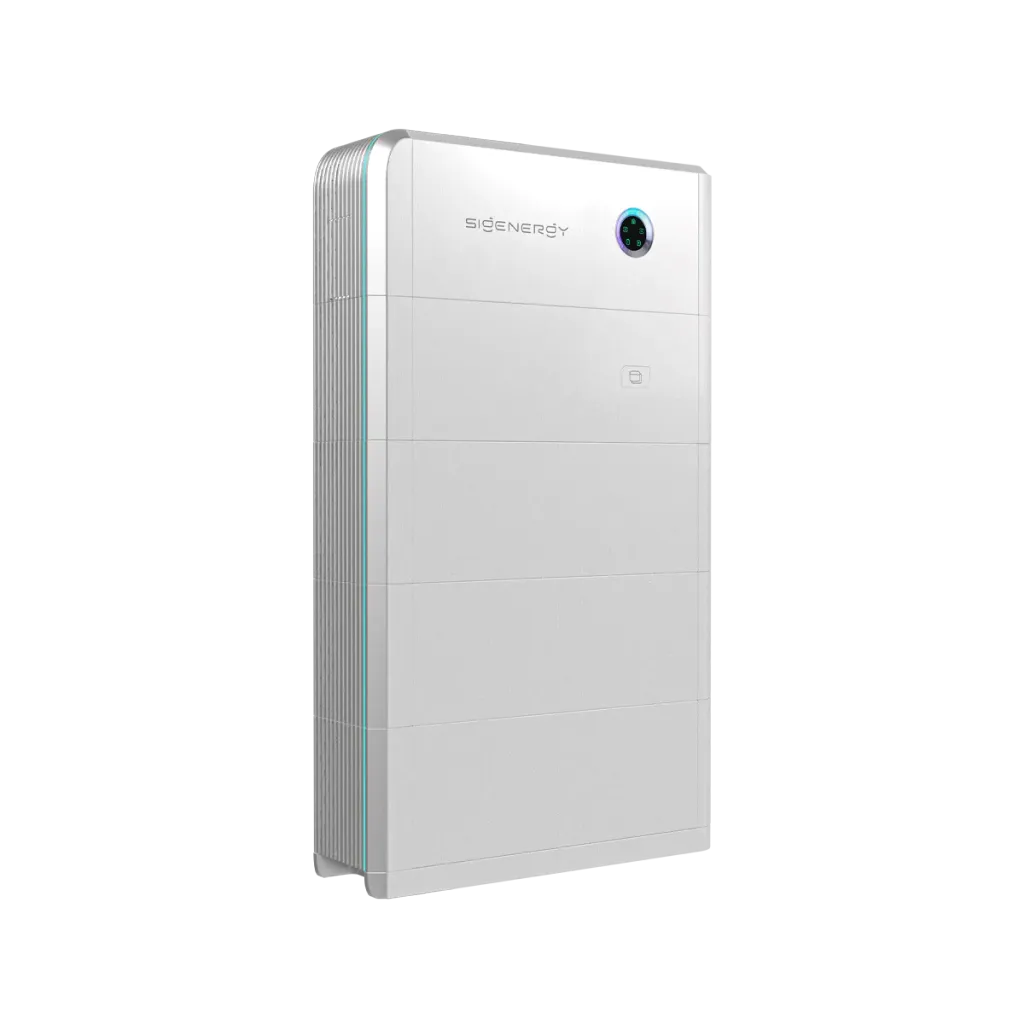
The Sigenergy SigenStor is a modular home energy storage system that combines a hybrid solar inverter, stackable battery modules, an optional DC EV-charging module and energy management in one slim floor-standing tower. Sigenergy calls it a "5-in-One" system, and the practical benefit is simple to state: one tidy unit instead of three or four separate boxes on your wall, and a battery that can grow after installation day. This page explains the SigenStor for UK homes using Sigenergy's own published figures. The battery systems in HCE's own battery storage job photos are EnSmart; if a SigenStor is the system you want, ask us and we will confirm in writing how it would be supplied, who installs and commissions it, and what warranty attaches.
In 2026 Sigenergy launched a second generation, the SigenStor Neo. If you are here for the SigenStor Neo UK position — release date, datasheet, price, stock — the short, dated answer is further down: as of 16 September 2026 the Neo is not yet in the UK supply chain, so the SigenStor available in the UK today is the original described on this page.
Who are Sigenergy?
Sigenergy is an energy storage manufacturer whose product range spans home and commercial storage (SigenStor and SigenStack), solar inverters, microinverters, gateways, EV chargers and the Sigen Cloud monitoring platform. The company publishes full specification and warranty documents for the European market, which is what every figure on this page is drawn from. Its home flagship, the SigenStor, has drawn attention in the UK for how much it folds into a single product. In 2026 Sigenergy launched a second generation, the SigenStor Neo — compared with the original below, with a dated note on where UK availability actually stands. Any quote should state the exact generation and configuration for your home, confirmed at survey.
 Manufacturer image
 The SigenStor system explained
A hybrid inverter sits at the top of the stack, LiFePO4 (lithium iron phosphate) battery modules sit beneath it, and the pieces connect with guided quick connectors that plug together automatically as the modules are stacked.
The published building blocks:
- Battery modules of 6.02 kWh or 9.04 kWh total energy capacity, each rated at 3,000 W or 4,600 W maximum charge and discharge respectively. Sigenergy quotes 100% depth of discharge of the usable capacity, with each module carrying its own DC-DC optimiser so modules work in parallel rather than dragging each other down.
- Hybrid inverters from 3.0 kW to 12.0 kW single-phase (three-phase versions run from 5.0 kW up to 30.0 kW), with 2 to 4 MPPT solar inputs depending on model. Sigenergy publishes maximum inverter efficiency of 97.6–98.0% for single-phase units and 98.1–98.4% for three-phase.
- An optional DC EV-charging module rated at 12.5 kW or 25 kW with a CCS2 connector. Because it taps DC power directly from the battery and panels, it supports bi-directional charging and is V2X-ready — vehicle-to-home and vehicle-to-grid — though Sigenergy notes that V2X functionality is limited by what your EV itself supports.
- Build quality: IP66 ingress protection, so the tower is rated for outdoor installation; the single-phase controller datasheet lists both natural convection and smart air cooling across the 3.0–12.0 kW range, and all three-phase units use smart air cooling; the batteries carry a five-layer protection scheme.
Because the design is modular and stackable, capacity is scalable on demand: start with a single module and add more later, and larger properties can run multiple SigenStor towers in parallel. Everything is monitored and controlled through the mySigen app.
 Manufacturer image
 Who the SigenStor suits
The SigenStor makes most sense for households that want room to grow. If you are planning a heat pump or an EV in the next few years but do not want to pay for a maximum-size battery today, the stackable design means capacity can be added without replacing the system. It is also the strongest candidate of the battery lines compared on this site for EV-focused homes: none of the others offers an integrated DC charging module of this kind, and 12.5–25 kW DC charging is considerably faster than the 7 kW AC wallboxes most UK homes use — worth weighing alongside our standard EV charger installations.
It is a premium product, and for a small household with modest evening usage a simpler single-battery system can be the more sensible spend.
Warranty, as Sigenergy publishes it
Sigenergy's European warranty document (dated 27 May 2025) sets out the terms plainly — worth reading before you buy anything:
- 10-year limited product warranty on SigenStor battery modules (BAT 5.0/6.0/8.0/10.0) and on SigenStor EC hybrid inverters.
- Performance warranty: the battery system is warranted to retain 60% of its usable energy for 10 years from installation, or to a minimum throughput energy figure per module (for example 20.44 MWh for the BAT 6.0), whichever comes first.
- The DC EV-charging module carries a shorter 3-year warranty.
- An internet connection is a condition: the system must stay connected for firmware updates. Disconnected for more than 90 days, it enters Safe Operation Mode; disconnected for more than a year cumulatively, warranty coverage adjusts to 5 years from activation.
- The document lists no SigenStor Neo model. As of 16 September 2026 Sigenergy's warranty page carries no Neo document either; the Neo appears there only in the site navigation.
Every home battery warranty is bounded — if a brochure implies a battery is guaranteed for good, that is the brochure talking, not the warranty document. These are the real terms, and any SigenStor quote should walk you through them.
SigenStor Neo: the short answer
The SigenStor Neo is Sigenergy's second-generation all-in-one home energy system, shown at the opening of the company's Nantong Smart Energy Center on 13 March 2026 (PSW Energy, 9 April 2026) and launched "globally" at Intersolar Europe in Munich on 24 June 2026 (Sigenergy newsroom, posted 25 June 2026). Sigenergy describes it as integrating "the inverter, battery, PCS, EMS, and gateway into a single system", supporting "up to six vertically stacked battery modules", with "0ms load-side disruption", "200% peakpower output capacity", an 8-layer protection scheme and — the genuinely new part — both a dedicated Smart Port and a Backup Port on the same unit. Sigenergy's own positioning is that it is "the first choice for families starting with solar and energy storage" (Sigenergy Neo product page) and "not a simplified version of SigenStor, but a focused evolution" (press release, 3 July 2026).
Two things a UK buyer needs to know before reading further. First, as of 16 September 2026 Sigenergy has not published a Neo datasheet, a Neo warranty document, a UK price or a UK release date — every figure attributed to the Neo below is either from Sigenergy's marketing page and press releases, or from launch-event coverage that its own authors describe as "based on manufacturer presentations, not independent lab testing or published datasheets" (PSW Energy). Second, we have found no UK distributor or stockist listing a Neo, so the SigenStor that can actually be bought in the UK today is the original described on this page. We keep the section below dated and re-check it every month; if you are deciding between waiting for a Neo and installing now, read UK availability first.
SigenStor Neo vs the original SigenStor, side by side
Sigenergy sells both systems concurrently — its own site lists "SigenStor Neo (new)" and "SigenStor" side by side — so this is a comparison between two current products, not old versus new. The left column is taken from Sigenergy's published datasheets and Europe warranty. The right column is what exists for the Neo: manufacturer marketing claims where Sigenergy has made them, and launch-event coverage where it has not. Rows marked "launch coverage" have no manufacturer datasheet behind them yet.
| Parameter | Original SigenStor (Energy Controller + BAT) | SigenStor Neo | Status |
|---|---|---|---|
| Architecture | Hybrid inverter, PCS and EMS in the Energy Controller, battery modules stacked beneath; whole-home backup needs the separate Sigen Energy Gateway (Energy Controller datasheet, footnote 4) | Inverter, battery, PCS, EMS and gateway "into a single system" (newsroom); "Backup module integrated" (product page) | Manufacturer-stated |
| Single-phase inverter sizes | 3.0 / 3.6 / 4.0 / 4.6 / 5.0 / 6.0 / 8.0 / 10.0 / 12.0 kW (datasheet) | 2.5–12 kW (PSW Energy); 5 / 6 / 8 / 10 / 12 kW (The Solar Guide, Australia) | Launch coverage — sources disagree |
| Three-phase inverter sizes | 5.0–30.0 kW, plus 5.0–12.0 kW low-voltage three-phase (datasheet) | 3–15 kW (PSW); 5 / 10 / 15 kW (Solar Guide) | Launch coverage — sources disagree |
| MPP trackers | 2, 3 or 4 by model; MPPT range 50–550 V single-phase, 160–1000 V three-phase (datasheet) | 4 MPPTs (product page) | Manufacturer-stated |
| Battery modules | BAT 6.0: 6.02 kWh total / 5.84 kWh usable; BAT 10.0: 9.04 / 8.76 kWh; the Europe warranty also lists BAT 5.0 and 8.0 (Battery datasheet; warranty) | 6 kWh and 8 kWh LFP (PSW; Solar Guide) | Launch coverage |
| Modules per stack | 1–6 per controller (datasheets) | "up to six vertically stacked battery modules" (newsroom) | Manufacturer-stated |
| Largest single stack | Datasheet arithmetic: 6 × BAT 10.0 = 54.24 kWh total / 52.56 kWh usable; Sigenergy's own marketing and UK distributor copy headline the stack as "up to 48 kWh" | "a maximum of 48 kWh in a single stack" (Solar Guide) | Launch coverage |
| Module charge / discharge | 3,000 W (BAT 6.0) / 4,600 W (BAT 10.0) continuous; 4,500 / 6,900 W for 10 s (Battery datasheet) | 0.8C against the original's 0.5C: an 8 kWh module ≈ 6.4 kW; four modules (32 kWh) ≈ 25.6 kW (PSW) | Launch coverage |
| Whole-home backup | Sigen Energy Gateway required (Energy Controller datasheet, footnote 4) | Integrated backup module (product page); 63 A integrated switch, "removing the need for an external gateway in most residential scenarios" (PSW) | Module: manufacturer. 63 A rating: launch coverage |
| Backup switchover | "Disruption time of backup switch: 0 ms" with the Gateway, under Sigenergy's stated test conditions (datasheet); PSW's table says 5 ms to backup / 0 ms restore | "0 ms load-side disruption" (product page; newsroom); "0ms (both directions)" (PSW) | Datasheet already claims 0 ms for the original — not a clear differentiator |
| Peak / overload output | "200% peak output power in off-grid mode"; "Peak output power (10 seconds): 2 times of nominal" (datasheet); PSW lists 150% | "200% peakpower output capacity ... even in off-grid mode" (newsroom); 200% for 10 s (PSW) | Datasheet already claims 200% for the original — not a differentiator |
| Battery protection | "5-layer battery safety protection" (Battery datasheet; product page) | "8-layer protection" (newsroom; press release) | Manufacturer-stated |
| Mixing old and new modules | "Battery optimizer inside, mix old and new" (Battery datasheet) | "mix old and new batteries via a built-in pack optimizer" (newsroom) | Both — not a differentiator |
| Thermal design | Battery: natural convection; controller: the single-phase datasheet lists both natural convection and smart air cooling across the 3.0–12.0 kW range, three-phase units smart air cooling | "Cell suspension": cells decoupled from the PCB with an air gap; heat exits via the enclosure walls (PSW) | Launch coverage |
| Terminals and monitoring | Perpendicular ports; standard over-voltage, under-voltage, over-current, short-circuit and over-temperature protection (PSW) | Angled ports for 16 mm² conductors; NTC temperature sensor at each terminal with automatic shutdown (PSW); "single side cover for wiring, and optimized terminal layout" (newsroom) | Launch coverage + manufacturer |
| Generator connection | Via the Gateway (PSW) | Direct to the unit — "Connect to a generator" (product page); grid-tied, off-grid and hybrid microgrid modes (PSW) | Manufacturer-stated (modes: launch coverage) |
| Smart Port (third-party inverter, heat pump, EV charger, generator) | Not offered | "dedicated Smart Port" for "third-party inverters, external generators, smart loads such as heat pumps or EV chargers" (newsroom); "Connect to your existing solar" (product page) | Manufacturer-stated |
| DC EV charging | Optional EVDC module: 12.5 or 25 kW, 150–1000 V, CCS2, bi-directional (EV DC module datasheet) | "To be confirmed" (PSW); "DC fast charging ... exclusive to the original SigenStor" (Solar Guide); the Neo page shows pairing with the Sigen EVAC 2 AC charger only | No source shows a DC module for the Neo |
| Communications | WLAN, Fast Ethernet, RS485, Sigen CommMod 4G (datasheet) | Sub-1G radio, "10 times coverage area" (product page — see the footnote caveat below) | Manufacturer-stated, caveated |
| Noise | Not stated on the datasheet | "<30 dB" (product page) | Manufacturer-stated |
| Ingress protection | IP66 (datasheets) | IP66 (product page) | Same |
| Warranty (Europe) | 10 years BAT and EC; 3 years EVDC; 60% usable energy at 10 years or a throughput cap, whichever first (warranty, 27 May 2025) | No Neo document on Sigenergy's warranty page as of 16 September 2026; PSW reports "10 years" from the launch | Unpublished |
| Datasheet | Published: Energy Controller (version 20260330), Battery, EV DC module | None — both datasheet fields on the product page are empty | Unpublished |
| UK stock (16 September 2026) | Listed at qualityheating.co.uk, powerland.co.uk, rapidrenewables.co.uk, midsummerwholesale.co.uk | Zero Neo products at all four | Not in the UK supply chain |
Footnote caveat: Sigenergy footnotes the Neo page "This data is the lab-measured results of Sigen Energy Gateway HomePro TP. Data for other Gateway models may vary" — the page does not say which figure it qualifies. The only kW numbers on the Neo page are illustrative values in an app-screen mock-up (9.6 kW solar, 5.6 kW home, 7.0 kW EVAC and so on), not specifications.
What is actually new, and what is not. Three of the Neo's headline numbers are already on the current datasheets for the original: "0 ms" backup switchover (with the Gateway), "200% peak output power in off-grid mode" and mixing old and new modules through the built-in optimiser. The differences Sigenergy itself has put in writing are the integrated backup and gateway function, the Smart Port plus Backup Port, 8-layer rather than 5-layer protection, and Sub-1G communications. The differences that matter most to an installer — the 0.8C charge rate, the cell-suspension thermal design, angled terminals with per-terminal temperature monitoring, and direct generator connection — come only from launch-event coverage and should be treated as provisional until a datasheet exists. What the Neo appears to give up is the DC EV charging module: no source we have read shows one for the Neo, and Sigenergy's own Neo page pairs it with the AC-charging Sigen EVAC instead.
Where each system fits. PSW Energy's own decision list, as PSW wrote it: the original Energy Controller "remains the right choice when" you need three-phase output above 15 kW (the EC goes to 30 kW), EV DC charging from day one, parallel stacking for commercial-scale capacity, or 5 kWh modules; the Neo "is the stronger fit when" you want whole-home backup without a separate gateway, you are in a hot climate, or installation simplicity matters most. Our own UK additions, drawn from Sigenergy's June 2026 material and the Neo product page: the Neo's Smart Port is the route for bolting storage onto an existing third-party solar inverter; its generator input needs no extra switching; and the Smart Port is designed to manage loads such as heat pumps and EV chargers — EV chargers being something HCE installs. None of that implies anything about Neo availability; read on.
SigenStor Neo UK availability and release date: what is confirmed (checked 16 September 2026)
Checked on 16 September 2026. Next scheduled re-check: 16 October 2026. If any item below changes we rewrite this section rather than patch it, and re-date both lines.
The short version: we cannot find any evidence that a SigenStor Neo can be bought, warranted or commissioned in the UK today, and Sigenergy has not published a UK release date. Here is what we checked and exactly what each source says.
What Sigenergy has said, in date order
- 13 March 2026 — the Neo was shown at the opening of Sigenergy's Nantong Smart Energy Center; the most detailed public account is from an Australian installer, PSW Energy, who attended (published 9 April 2026).
- 24–25 June 2026 — Sigenergy's newsroom: "globally launching its complete home energy ecosystem at Intersolar Europe 2026" in Munich. No country list, no dates, no prices.
- 3 July 2026 — press release: "announced the global rollout of SigenStor Neo" and "SigenStor Neo is available globally". It names no UK channel, price or date. "Available globally" is a corporate statement, not a stock position.
- 28 August 2026 — a country launch: an event in Bangkok at which Sigenergy "announced official product pricing" for Thailand. The figures were not published. This is what a market launch looks like. We have found no equivalent announcement for the UK or Europe.
What has not been published (as of the check date)
- No datasheet. The datasheet fields on Sigenergy's Neo product page are empty; the only PDF the page links to is the Sigen CommMod 4G module datasheet. The original SigenStor has three published datasheets — Energy Controller, Battery, EV DC Charging Module.
- No warranty. The Europe SigenStor warranty (27 May 2025) lists BAT 5.0/6.0/8.0/10.0, EC SP 3.0–12.0, EC TP 5.0–30.0, EVDC 12/25 and BC — no Neo model; Sigenergy's warranty page carries no Neo document.
- No UK stock. On 14 September 2026 qualityheating.co.uk listed 45 Sigenergy products and powerland.co.uk 72, rapidrenewables.co.uk 18 and midsummerwholesale.co.uk its SigenStor range — none included a Neo, and none did when we re-checked on 16 September 2026.
- No UK price. None of the above, and nothing on Sigenergy's page.
- Other UK installers writing about the Neo say the same: "UK-specific models, availability, pricing and applicable grid approvals should be confirmed before specifying a system" (UK Green Energy Installations, 7 September 2026).
What would change this section. Any one of: a Neo datasheet appearing on sigenergy.com; a Europe warranty document listing Neo model numbers; a Neo SKU at a UK distributor; or a UK launch announcement with pricing, as Sigenergy did for Thailand. When one of these happens we will say so here, with the date and the link — and we will still not quote lead times or stock we have not seen.
What this means if you are choosing now. The original SigenStor is purchasable in the UK with published datasheets, a published Europe warranty and UK stock. The Neo is not yet in the UK supply chain. If the features you want are Neo-specific — integrated backup without a Gateway, the Smart Port, direct generator input — the honest advice is to wait for a datasheet and a UK price before committing; if you want DC EV charging, the original is the only SigenStor that offers it. Whichever you choose, it should be designed from your actual consumption — and a Neo only once the product exists to design with. For the running record, see our SigenStor Neo UK tracker post.
Which Neo specification is current? Two launches, two descriptions
There are two public descriptions of the Neo and they do not fully agree, because the product was described twice — once at the Nantong factory opening in March and again at Intersolar Europe in June.
The March 2026 description (as documented by PSW Energy on 9 April 2026): inverter ranges of 2.5–12 kW single-phase and 3–15 kW three-phase; 6 kWh and 8 kWh modules; a 63 A integrated backup switch; 0.8C charging; cell-suspension cooling; angled terminals with NTC monitoring; direct generator input; DC EV charging "to be confirmed"; no mention of a Smart Port. PSW's own caveat applies to all of it: "compiled from launch event coverage based on manufacturer presentations, not independent lab testing or published datasheets."
The June 2026 description (Sigenergy's own newsroom, 25 June 2026, repeated by PV Tech on 28 June and the 3 July press release): the five subsystems in one unit; up to six modules; 0 ms and 200% peak; an 8-layer protection scheme; both a Smart Port and a Backup Port; a built-in pack optimiser for mixing old and new modules; lighter modules with lifting handles and a single side cover for wiring; direct pairing with the SigenMicro microinverter, the SigenFlux heat pump and the Sigen EVAC G2 charger. It gives no kW or kWh figures at all.
For a UK reader the June description governs: it is Sigenergy's own, it is the European launch, and it is more recent. The March figures fill in the numbers the June material omits, and that is the only reason to use them — always with the caveat that they pre-date any datasheet. The March coverage does not mention the Smart Port that Sigenergy's June material introduces. Where a later Australian source gives different model steps (5/6/8/10/12 kW single-phase; 5/10/15 kW three-phase — The Solar Guide, 1 June 2026) it is another pre-datasheet account, so we show both rather than pick one.
The engineering behind the Neo claims
Charge rate. The original SigenStor battery modules are rated for 3,000 W (BAT 6.0) or 4,600 W (BAT 10.0) continuous charge and discharge, with a 10-second peak of 4,500 / 6,900 W (Battery datasheet). Launch coverage puts the Neo's modules at 0.8C against the original's 0.5C, which for an 8 kWh module is roughly 6.4 kW and for a four-module 32 kWh stack roughly 25.6 kW of charging power (PSW). Treat the 0.8C figure as provisional until a datasheet confirms it, and remember the inverter's own rating caps what the stack can draw from the grid in any case.
Thermal design. PSW describes the Neo's "cell suspension" architecture: "Battery cells are physically separated from the PCB, creating an air gap that interrupts the direct thermal pathway. Heat generated by the cells dissipates through the enclosure walls." The original's battery datasheet lists natural-convection cooling and an operating range of −20 to 55°C; the Europe warranty recommends a 10–30°C working temperature for battery life. In a UK garage or on an outdoor north wall the practical question is the cold end, not the hot end, and no Neo source yet publishes low-temperature charge behaviour — a datasheet item to watch for.
Backup and overload. Sigenergy states the Neo delivers "0ms load-side disruption and 200% peakpower output capacity, ensuring worry-free operation even in off-grid mode" (newsroom). Be aware the original claims the same on its current datasheet — "Disruption time of backup switch: 0 ms" (with the Gateway, under stated test conditions) and "200% peak output power in off-grid mode". What changes with the Neo is that the backup function is inside the unit — Sigenergy lists "Backup module integrated" — and PSW reports a 63 A switch "removing the need for an external gateway in most residential scenarios". A 63 A switch does not raise the inverter's output; a 5 kW Neo still backs up 5 kW of load, plus the short-duration peak.
Terminals, monitoring and installation. PSW reports angled inverter terminal ports sized for 16 mm² conductors, an NTC temperature sensor at every terminal feeding the energy management system with an automatic shutdown if a threshold is exceeded, "no proprietary tooling or specialist crimps required", and a software cabling-layout tool that generates a standard wiring diagram per configuration. Sigenergy's June material confirms the direction — "Lightweight modules with lifting handles, a single side cover for wiring, and optimized terminal layout."
Ports. The Neo carries a Smart Port and a Backup Port. Sigenergy: the Smart Port "can seamlessly connect third-party inverters, external generators, smart loads such as heat pumps or EV chargers", and the Backup Port "ensures a highly flexible, extended power supply to keep whole-home loads running smoothly during unexpected grid blackouts". The Neo page lists "Connect to your existing solar", "Connect to a generator", "Pair with Sigen EVAC 2" and "Pair with SigenFlux". In UK terms the Smart Port is the AC-coupling path: it is how a Neo would be added to a home that already has a solar inverter from another brand.
Solar input, communications, noise. Four MPP trackers (product page) versus two to four on the original depending on model; Sub-1G radio with a claimed "10 times coverage area" (product page, with the lab-measured footnote noted above); under 30 dB; IP66 on both generations.
What the Neo does not appear to have. A DC EV charging module: PSW lists it as "To be confirmed", The Solar Guide says DC fast charging is "exclusive to the original SigenStor" and that the Neo supports AC charging at 7, 11 and 22 kW, and Sigenergy's own Neo page pairs it with the Sigen EVAC AC charger. The original's EVDC module is rated 12.5 or 25 kW at 150–1000 V on CCS2.
Grid connection in the UK: G98 or G99 for these inverter ratings
Every grid-tied inverter in Great Britain connects under one of two Energy Networks Association recommendations, and which one applies is decided by the inverter's AC rating per phase, not by the battery size.
The line is 16 A per phase. ENA EREC G98 (Issue 2, 10 March 2025) covers fully type-tested micro-generators up to and including 16 A per phase, which corresponds to 3.68 kW on a single-phase supply and 11.04 kW on a three-phase supply at nominal 230/400 V. Battery systems count: "Electricity Storage devices shall meet the requirements of this EREC G98", and the ENA's plain-English guide adds "For the avoidance of doubt this includes electricity storage devices". Above that line, ENA EREC G99 (Issue 2, 10 March 2025) applies to "generation and energy storage installations that are either rated above 16A (3.68kW) per phase or that do not meet" G98.
The process difference is the part homeowners feel. G98 is connect-and-notify: the installer may fit and commission first and must inform the network operator "before the time of commissioning or no later than 28 days ... after commissioning", via the ENA Connect Direct platform with a photograph of the cut-out. G99 is apply-first: "The Generator should apply to the local DNO for connection using the DNO's Standard Application Form", the DNO assesses whether network studies are needed, and "On successful completion of the commissioning tests, the DNO will sanction permanent energisation". Domestic-scale G99 systems are Type A (0.8 kW to below 1 MW) and use the simplified Form A1-1 where the total aggregate capacity is under 50 kW three-phase or 17 kW single-phase; 17 kW is also the maximum aggregate capacity G99 permits on a single-phase supply.
| Inverter rating | Original SigenStor model (datasheet) | Neo (reported sizes — PSW / Solar Guide) | Route |
|---|---|---|---|
| 2.5 kW single-phase | — | 2.5 kW (PSW) — about 10.9 A at 230 V | G98 |
| 3.0 kW single-phase | EC 3.0 SP, 13.6 A nominal | — | G98 |
| 3.6 / 3.68 kW single-phase | EC 3.6 SP, 3,680 W, 16.0 A nominal | — | G98 (this is the ceiling) |
| 4.0 kW and above single-phase | EC 4.0 SP (18.2 A) up to EC 12.0 SP (54.6 A) | 5, 6, 8, 10, 12 kW (Solar Guide) | G99 Type A, Form A1-1 (≤17 kW single-phase) |
| Up to 11.04 kW three-phase | EC 5.0 / 6.0 / 8.0 / 10.0 TP | 3, 5, 10 kW (PSW; Solar Guide) | G98 |
| 12 kW and above three-phase | EC 12.0–30.0 TP | 12, 15 kW (PSW; Solar Guide) | G99 Type A, Form A1-1 (≤50 kW) |
The practical consequence: the only single-phase SigenStors on either platform that can be fitted on the notify-after route are the 2.5–3.68 kW sizes. Most homes asking about a 5–12 kW hybrid — which is where the Neo's reported range sits — are G99 applications that must be lodged with, and accepted by, the DNO before commissioning. That affects the programme: a G99 application goes in at design stage, not the week of installation.
Two refinements. First, capacity is aggregate per premises: G99's own worked example is "1 x 3.68 kW PV Inverter plus 1 x 3.68 kW Electricity Storage device = 7.36 kW" — relevant to a Neo added through its Smart Port to an existing solar inverter, because the existing inverter counts. Second, G99 defines Registered Capacity as something that "can be limited (eg by software) to be less than the Intrinsic Design Capacity", and contains a Small Generation Installation route (Form A1-2) built around an EREC G100 export-limitation scheme. Whether a given SigenStor configuration can use an export-limited route depends on its type-test registration and your DNO's view; it should be checked at survey rather than assumed. None of this is Neo-specific — the Neo simply has no ENA type-test record we can point to yet, which is one more reason its UK availability is unconfirmed.
HCE handles the G98 notification or G99 application for the battery systems we fit as part of our battery storage work; for a SigenStor, any quote should say who makes that submission to your network operator.
The Smart Export Guarantee with a SigenStor (either generation)
The Smart Export Guarantee pays you for electricity you export, but it is a generation scheme, not a battery scheme. Ofgem lists the eligible technologies as solar PV, wind, hydro and anaerobic digestion up to 5 MW, and micro-CHP up to 50 kW. The supplier sets the rate and contract terms, the rate "must always be above zero", and "SEG payments are calculated by using export meter readings".
What you need. Your installation and installer must be certified under MCS "or a scheme accredited as equivalent, such as the Flexi-Orb renewables scheme", and "You must have a meter capable of providing half-hourly export readings. This would typically be a smart meter" (GOV.UK). Where HCE fits the solar panels, the SEG-relevant certificate is for the solar PV installation — HCE is MCS-certified for solar PV via NAPIT (member 73495).
Where the battery comes in. GOV.UK: "If you have a storage device, such as a household battery or electric vehicle, that has the ability to import and export electricity, it could also be used to benefit from the SEG." The catch is what the supplier will pay for. Energy Saving Trust (updated 20 May 2026): "Energy suppliers don't have to pay you for non-renewable electricity exported to the grid, but some may choose to do so. Some suppliers may only pay the SEG for the electricity your low-carbon system generates itself." A SigenStor of either generation is a DC-coupled hybrid — solar and battery share one inverter and one export meter — so exported energy can include electricity that was bought off-peak and discharged later. Whether that is paid, ignored or excluded is a matter of the individual tariff's terms. We do not promise a rate, and we suggest reading the supplier's SEG terms before choosing a charge schedule in the mySigen app.
Neo-specific note: the SEG rules do not care which generation you have. What the Neo's Smart Port changes is that a battery could be added to an existing MCS-certified solar array from another brand; the SEG certificate would still be the original PV certificate, and the export-meter and tariff-terms points above apply unchanged.
Price in the UK: what is published and what is not
SigenStor Neo. There is no UK price. Sigenergy's Neo page carries none; none of the four UK stockists and distributors we checked lists a Neo; the only pricing Sigenergy has announced anywhere is for Thailand, and it did not publish the figures. We will not estimate a UK Neo price from overseas launches, and you should be wary of anyone who does.
Original SigenStor — component prices seen at UK retailers (supply only, 14 September 2026; these are their prices, not HCE quotes, and they move). At qualityheating.co.uk: SigenStor battery module (BAT LED, 5–9 kWh) from £2,500 inc VAT (£2,083.33 exc); Energy Controller single-phase 3.6–12 kW from £1,130 inc VAT; Energy Controller three-phase 10–25 kW from £2,050 inc VAT; EV DC charging module 12/25 kW from £1,795 inc VAT; Sigen Energy Gateway HomePro SP-F 100 A £970 inc VAT. At powerland.co.uk (prices excluding VAT): Battery 6.0 £2,423.97; Battery 10.0 £3,106.77; Energy Controller 3.6 kW single-phase £1,151.00; 5.0 kW £1,231.74; 8.0 kW £1,901.06; 12.0 kW £2,242.86; Gateway HomePro SP-F £1,094.58; EV DC module 25 kW (5 m) £2,447.66. Put the pairings together and a single-module, single-phase kit is about £3,575 exc VAT for a Battery 6.0 with a 3.6 kW controller (powerland.co.uk) or about £3,630 inc VAT on qualityheating.co.uk's "from" prices, rising to about £5,350 exc VAT for a Battery 10.0 with a 12.0 kW controller (powerland.co.uk) — hardware only, before installation, gateway, EV module or VAT treatment, and not a quote.
Installed system estimates published by a third party ("last reviewed September 2026", solarinfo.uk): 6 kWh with a 5 kW controller £3,500–£4,500; 9 kWh / 8 kW £4,500–£6,000; 12 kWh / 10 kW £5,500–£7,000; 18 kWh / 10 kW £7,500–£9,600; DC EV module "typically costs from £3,500 extra". These are that publisher's estimates, not HCE's; any real quote should come from a survey of your consumption, consumer unit and DNO position.
VAT. Installation of energy-saving materials in residential accommodation is zero-rated across the UK until 31 March 2027, after which HMRC says supplies "revert to the reduced rate of VAT of 5%"; electrical battery storage has been included since 1 February 2024, covering both batteries retrofitted to solar and "a standalone battery for storing electricity from the grid" (VAT Notice 708/6). The zero rate applies to supply-and-install by the installer — in HMRC's words, "if you supply energy-saving materials without installing them your supply will be standard-rated" — so the retail prices above carry standard VAT, one reason a professionally installed quote can be closer to the hardware price than the sticker suggests. More on this in our guide to 0% VAT on solar panels and batteries.
Four checks before any Sigenergy system is quoted
Before a SigenStor of either generation goes into any quote, four things should be checked, and you should be told the result: (1) that the exact model numbers appear in Sigenergy's current Europe warranty document — the Neo does not, yet; (2) that a manufacturer datasheet exists for each component being specified — the Neo has none, yet; (3) the G98 or G99 route for the aggregate inverter capacity at your property, and the DNO's timescale for it; and (4) the product's certification status, checked on the day, rather than assumed from a brochure. If any of those four is missing, the installer should say so rather than install around the gap.
HCE's own credentials, stated exactly: NAPIT member 73495; MCS-certified for solar PV via NAPIT; member of the HIES Consumer Code, HCE/A/1392. We hold no manufacturer installer-programme tier with Sigenergy and do not claim one; every specification on this page comes from Sigenergy's published documents, each linked in the sources below.
How a SigenStor installation should work
- Step 1
Initial consultation
A free, no-obligation conversation with us about your usage, your goals and whether the SigenStor is genuinely the right fit — if another system suits you better, we say so, and if a SigenStor is what you want, we confirm in writing who would supply, install and commission it.
- Step 2
Your design and survey
The installer surveys the property, checks your consumer unit and DNO connection, and designs the stack: module count, inverter size, and whether the EV module earns its place.
- Step 3
Final installation
The installer fits, commissions and registers the system, sets up the mySigen app with you, and leaves you with the warranty documents and an itemised record of what was fitted.
HCE is MCS-certified for solar PV via NAPIT (member 73495) and a member of the HIES Consumer Code (HCE/A/1392).
Sources for the figures on this page
- Sigenergy — SigenStor Neo product page (read 16 September 2026) · SigenStor product page · newsroom, Intersolar Europe 2026 launch (posted 25 June 2026) · warranty documents page.
- Sigenergy datasheets — Sigen Energy Controller (version 20260330) · Sigen Battery · Sigen EV DC Charging Module · Factory Limited Warranty for SigenStor (For Europe), 27 May 2025.
- Press — GlobeNewswire, 3 July 2026 (global rollout) · GlobeNewswire, 28 August 2026 (Thailand launch) · PV Tech, 28 June 2026.
- Launch coverage (pre-datasheet) — PSW Energy, SigenStor Neo technical deep dive, 9 April 2026 · The Solar Guide (Australia), 1 June 2026 · UK Green Energy Installations, 7 September 2026.
- UK stockists and distributors (checked 14 and 16 September 2026) — qualityheating.co.uk · powerland.co.uk · rapidrenewables.co.uk · midsummerwholesale.co.uk · installed estimates: solarinfo.uk.
- Grid — ENA EREC G98 Issue 2 (10 March 2025) · ENA EREC G99 Issue 2 (10 March 2025) · ENA guide, G98 single premises · National Grid, G99 connection procedures.
- Export and VAT — Ofgem, Smart Export Guarantee · GOV.UK, Smart Export Guarantee · Energy Saving Trust, Smart Export Guarantee (updated 20 May 2026) · HMRC, VAT Notice 708/6.
By region
By region
Region by region: the housing, the network operators and the sunshine figures that shape how this system would fit.
Surrey
Sussex
Hampshire
Berkshire
South West London
North London
Hertfordshire
Essex
Bedfordshire
Buckinghamshire
Sigenergy and SigenStor Neo FAQs
Can the SigenStor charge my electric car?
Yes — with the optional DC charging module, rated at 12.5 kW or 25 kW with a CCS2 connector. Because it draws DC power straight from the battery and solar array, it can charge faster than a standard 7 kW home wallbox and supports bi-directional (V2X) charging where the vehicle allows it. The module carries its own 3-year warranty, shorter than the 10-year battery term, and compatibility with your car should be confirmed before it is quoted.
Can I add more battery capacity later?
Yes — that is the system’s defining feature. Battery modules of 6.02 kWh or 9.04 kWh stack beneath the inverter and connect automatically, so adding a module is a short engineer visit rather than a new system. Larger homes can also run multiple towers in parallel. The initial stack should be designed with growth in mind, so the inverter is sized correctly from day one.
Will it keep my lights on in a power cut?
Backup configurations are supported — Sigenergy’s range includes the gateway hardware needed to island your home from the grid, and Sigenergy publishes a home load backup calculator for exactly this purpose. Whether whole-home or essential-circuits backup makes sense depends on your consumer unit and what you want to keep running; it should be specified at the design stage rather than as an afterthought.
Is the SigenStor safe to install outdoors?
Yes, within Sigenergy’s installation requirements. The unit carries an IP66 ingress protection rating, and the batteries are LiFePO4 chemistry with a five-layer protection scheme. Location still matters — ventilation and temperature affect battery life, and the recommended working temperature is 10–30°C — so the position should be chosen at survey.
What are the differences between the SigenStor Neo and the SigenStor?
Both are all-in-one hybrid inverter-plus-stacked-battery systems that Sigenergy sells side by side. The differences Sigenergy itself has put in writing are: the Neo integrates the gateway and backup function into the unit ("Backup module integrated") instead of needing the separate Sigen Energy Gateway the original uses for whole-home backup; it adds both a Smart Port — for third-party inverters, generators, heat pumps and EV chargers — and a Backup Port; it moves from 5-layer to 8-layer battery protection; and it uses Sub-1G radio. Launch-event coverage, which has no datasheet behind it yet, adds a 0.8C charge rate (versus 0.5C), a cell-suspension thermal design, angled terminals with per-terminal temperature sensors, direct generator input, 6 and 8 kWh modules and reported ranges of 2.5–12 kW single-phase and 3–15 kW three-phase. Three headline Neo numbers — 0 ms backup switchover, 200% off-grid peak output and mixing old and new modules — are already on the original’s current datasheets, so they are not differences. What the Neo appears to lack is the original’s optional 12.5/25 kW DC EV charging module; every source we have read shows the Neo paired with an AC charger instead.
When is the SigenStor Neo being released in the UK?
Sigenergy has not published a UK release date. The Neo was first shown on 13 March 2026, launched "globally" at Intersolar Europe in Munich on 24 June 2026, and described in a 3 July 2026 press release as "available globally" — but that release names no UK channel, date or price, and the only country-specific launch with pricing so far was Thailand on 28 August 2026. As of 16 September 2026 there is no Neo datasheet, no Neo entry in the Europe warranty, and no Neo listed at any of the four UK Sigenergy stockists and distributors we checked (qualityheating.co.uk, powerland.co.uk, rapidrenewables.co.uk, midsummerwholesale.co.uk). We re-check monthly and update this page with the date and the link when any of that changes. Until then the SigenStor you can actually buy in the UK is the original.
Is there a SigenStor Neo datasheet?
Not as of 16 September 2026. The datasheet fields on Sigenergy’s own Neo product page are empty, and the only document the page links to is the datasheet for the Sigen CommMod 4G communications module. The figures circulating online for the Neo come from launch-event coverage — the most detailed, from PSW Energy, carries its own warning that the data is "compiled from launch event coverage based on manufacturer presentations, not independent lab testing or published datasheets." By contrast the original SigenStor has three published datasheets (Energy Controller, Battery, EV DC Charging Module), which is what every figure for it on this page is drawn from. When a Neo datasheet appears we will link it here.
How much does the SigenStor Neo cost in the UK — and how much does a Sigenergy system cost?
There is no UK price for the Neo: Sigenergy has published none, no UK stockist lists one, and the only Neo pricing announced anywhere (Thailand, 28 August 2026) was not made public. We will not guess. For the original SigenStor, UK retailers on 14 September 2026 were listing components at roughly: battery module from £2,500 inc VAT (qualityheating.co.uk) or £2,423.97 exc VAT for the 6.0 (powerland.co.uk); single-phase Energy Controller from £1,130 inc VAT; three-phase controller from £2,050 inc VAT; EV DC module from £1,795 inc VAT; Energy Gateway about £970–£1,095. One independent UK guide estimates installed systems at £3,500–£4,500 for 6 kWh with a 5 kW controller, rising to £7,500–£9,600 for 18 kWh. Installation of battery storage in a home is zero-rated for VAT until 31 March 2027 (then 5%), which is why an installed quote can sit closer to hardware cost than retail prices suggest. Those figures are other people’s prices, not ours; any real quote should come from a survey of your actual usage.
Who are the Sigenergy installers in the UK?
Sigenergy supplies the UK through trade distributors and its website carries a "Find an Installer" tool; beyond that there is no public UK list to point you to. What to check with any installer, whichever brand they fit: that they hold an MCS certification for solar PV through a certification body such as NAPIT (the certificate the Smart Export Guarantee requires); that they belong to a consumer code such as HIES; that they will handle the G98 notification or G99 application to your network operator themselves; and that they will show you the manufacturer’s datasheet and warranty for the exact model numbers quoted. HCE is NAPIT member 73495, MCS-certified for solar PV via NAPIT, and a member of the HIES Consumer Code (HCE/A/1392). We hold no manufacturer installer tier with Sigenergy and do not claim one. The battery system in HCE’s own job photos is EnSmart; if a SigenStor is the system you want, ask us and we will confirm in writing how it would be supplied, who installs and commissions it, and what warranty attaches — and a Neo should not be quoted by anyone until it is in the UK supply chain with a datasheet and warranty behind it.
Want to know whether a SigenStor suits your home — and how it would be supplied, installed and warranted, in writing?
Request your free quote or call 0204 547 1892. You can also compare it with the Tesla Powerwall 3 and EcoFlow PowerOcean, or read our side-by-side SigenStor vs Powerwall 3 comparison. For the running record of what is and is not confirmed about the Neo in the UK, see our tracker post. On the south coast, where strong summer generation rewards storage, see our page on Sussex installations for the local picture.