
Sussex
Solar Panel Installation in East & West Sussex
HIES Consumer Code member · NAPIT registered · MCS certified · Trustpilot reviewed
Ask the Met Office where mainland Britain gets its most sunshine and the answer is the south coast of England — over 1,750 hours a year on average. Sussex sits squarely on it. From Chichester and Worthing along to Brighton, Eastbourne and Hastings, and inland through Crawley, Horsham and Lewes, homes here have a head start on solar that most of the country would envy.
Home Comfort Enterprises (HCE) fits solar panels, battery storage and EV charge points for homeowners across East and West Sussex — one page for both counties, because the sunshine doesn't check the boundary sign. We've been installing since 2021, we're MCS-certified with NAPIT registration and HIES Consumer Code membership, and we work the way we'd want to be sold to: clear numbers, written quotes, and no pressure at any point.
The town pages go a level deeper than this one: solar panels Crawley and solar panels Horsham each carry a PVGIS yield run for the town itself, the council's own schemes and the conservation-area position.
Quick answer
Solar panels in Sussex:
- Eastbourne averages 1,892 sunshine hours a year (Met Office, 1991–2020) — among the sunniest records in Britain
- Crawley’s planned post-war rooflines suit straightforward installs; Brighton and Hastings terraces get a design that reflects the building
- Solar Together Sussex has fitted panels to more than 1,600 homes across its first three phases (East Sussex County Council)
- Typical national install cost: around £7,600 for a 4.5 kWp system (Energy Saving Trust, 27 August 2026) — a UK figure, not a Sussex price
- MCS-certified, NAPIT-registered and a HIES Consumer Code member
- Solar and battery installations are zero-rated for VAT until 31 March 2027
Figures: Met Office / East Sussex County Council / Energy Saving Trust, July 2026.
Why solar works in Sussex
Sussex has a genuine, measurable sunshine advantage. Eastbourne's Met Office averages show 1,892 hours of sunshine a year (1991–2020) — roughly 35% more than the UK average of about 1,400 hours — and Bognor Regis records around 1,919 hours, which puts both towns among the sunniest in Britain. The pattern isn't a seaside myth: the coastal strip sits in the lee of the South Downs, which wring rain out of weather systems before they reach the shore. Every extra bright hour is generation a solar array collects for free.
Both county councils are pushing in the same direction, on different timetables. West Sussex County Council pledged in April 2019 to make its own operations carbon neutral by 2030, and reports that its Solar Together group-buying rounds have enabled around 2,500 home solar installations, alongside nearly 80,000 MWh of renewable energy generated from its own solar farms and rooftop arrays. East Sussex County Council declared a climate emergency in October 2019, targets net zero by 2050 at the latest, and is now working to its Climate Emergency Plan 2025–30; it reports more than 1,600 homes fitted with panels through the first three phases of Solar Together Sussex. Thousands of Sussex households have already made the move — through council schemes or, like most of our customers, independently.
You can even see the county's energy transition from the beach. The Rampion Offshore Wind Farm's 116 turbines stand 13–25km off the coast between Worthing and Newhaven, generating enough electricity for around 400,000 homes — roughly half the households in Sussex — with the consented Rampion 2 extension set to add more. Rooftop solar is the household-scale end of the same shift.
The housing stock rewards local knowledge. Crawley was designated a New Town on 9 January 1947, and its planned post-war neighbourhoods offer regular, uncomplicated rooflines that make for straightforward installs. The Victorian and Edwardian terraces of Brighton, Hove and Hastings are a different job — steeper pitches, chimneys, shared access for scaffolding, and more conservation areas — still very workable, but the design and the quote need to reflect the building in front of us rather than a generic template.
What we install
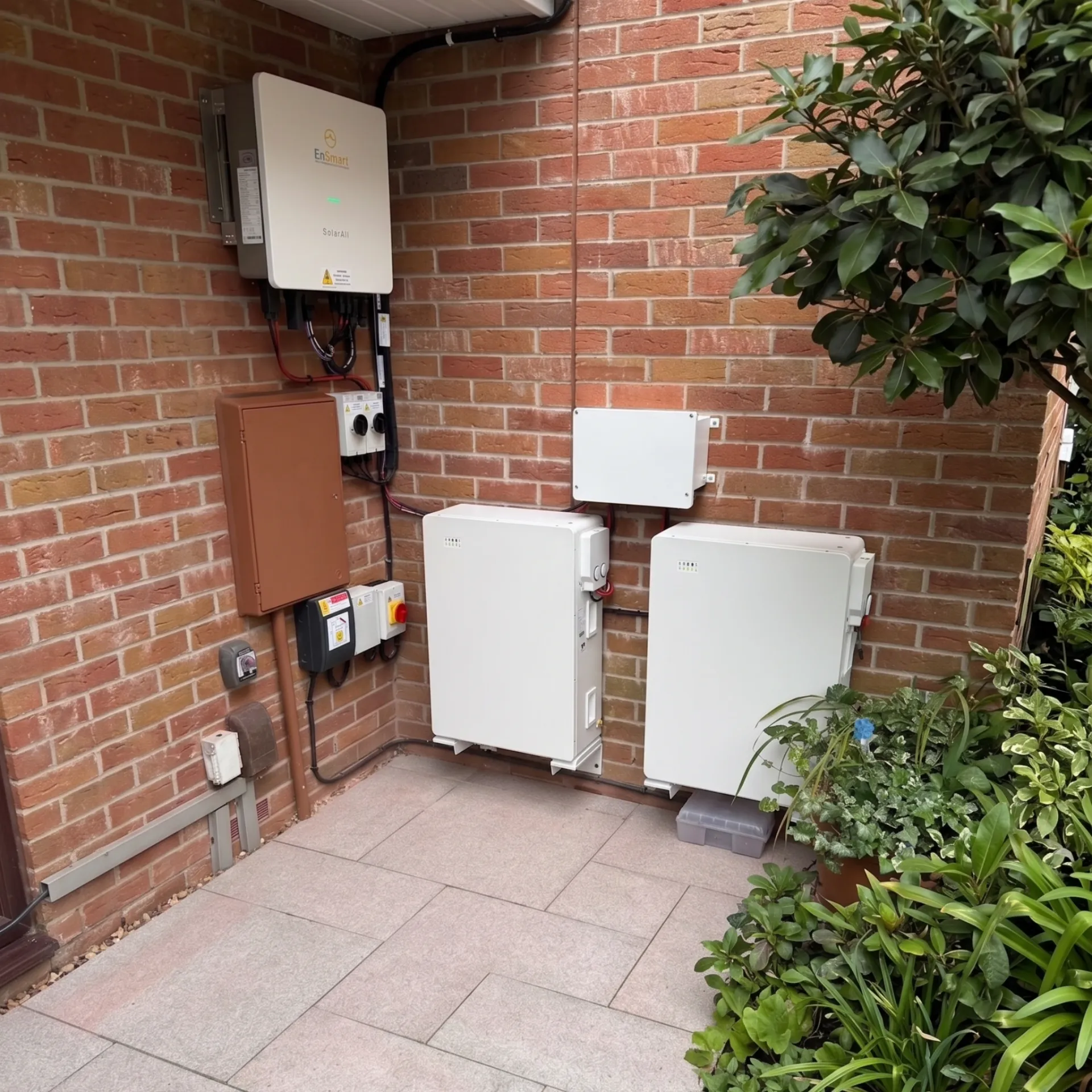
Panels, batteries, inverters and EV chargers — specified together, because they work as a system. A Sussex roof with strong summer generation and nobody home until 6pm usually earns its battery; a household charging an EV overnight changes the maths again. We model your actual usage before recommending anything, and we include EnSmart storage systems among the equipment we fit.
Two honest numbers to hold onto: panels are built to last 25–30 years, while battery and inverter warranties are bounded — typically around ten years from the manufacturer. Both belong in your payback sums, and we'll walk you through them line by line.
Start with a conversation
A no-pressure route from enquiry to install
It starts with a free callback to talk through your home and what you're trying to achieve. Next comes the survey and design: we measure, check shading and the electrical setup, and give you a written, itemised quote — valid whether you decide this month or next year. The installation itself typically takes one to two days. At no point will anyone from HCE lean on you to sign; that's a promise we've kept since day one.
Across Sussex
Batteries and EV chargers across Sussex
Each town page runs that town's own sunshine figures, network operator and housing; the brand pages compare the batteries we are asked about most.
Costs, grants and planning
Battery storage by town
EV chargers by town
Solar panels in Sussex — common questions
Does HCE cover both East Sussex and West Sussex?
Yes — HCE works across both East and West Sussex, and the approach is the same wherever you are: a free, no-pressure survey first. Add your postcode to the quote form and we'll confirm the details for your address when we arrange it.
Do I need planning permission in the South Downs National Park or a conservation area?
For most roofs, no — domestic solar is normally permitted development in England, and that includes homes inside the South Downs National Park, which stretches 1,627 km² from Winchester to the cliffs at Eastbourne through both Sussexes. The exceptions are specific: in conservation areas (common in Lewes, Rye, Arundel and central Brighton), panels must not be fitted to a wall fronting a highway; listed buildings always need listed building consent; and a handful of streets carry Article 4 directions that remove permitted development rights. Inside the park, the South Downs National Park Authority is the planning authority. We check at survey stage and tell you plainly if your address needs a consent before work starts.
Is the Sussex coast really one of the sunniest places in the UK?
Yes — it’s in the Met Office record, not just the tourist brochures. Eastbourne’s 1991–2020 average is 1,892 hours of sunshine a year against a UK average of roughly 1,400, and Bognor Regis is higher still at about 1,919 hours. Inland Sussex sees a little less than the coastal strip, but the whole county sits in the brightest corner of mainland Britain — which feeds directly into what an array here generates.
How disruptive is the installation?
Less than most people expect: the typical Sussex home takes one to two days on site. Scaffolding usually goes up a day or two beforehand and comes down within the week — worth knowing on terraced streets in Brighton or Hastings where access needs a word with the neighbours. Power is only briefly interrupted while the inverter is connected, and we leave the system running, explained and demonstrated before we go.
Towns we cover
Local pages for Sussex towns
Each town page below is built from named public sources — census housing figures, council schemes and local planning context — rather than template filler.
Find out what a Sussex roof can do
Tell us where you are — coast or Weald, terrace or new build — and we'll give you a straight, itemised answer with no follow-up pressure. Call 0204 547 1892 or request a free quote. Go Green, Go Solar, Go HCE.
Also see: Surrey solar installation · solar panels across Hampshire · Berkshire · south-west London