
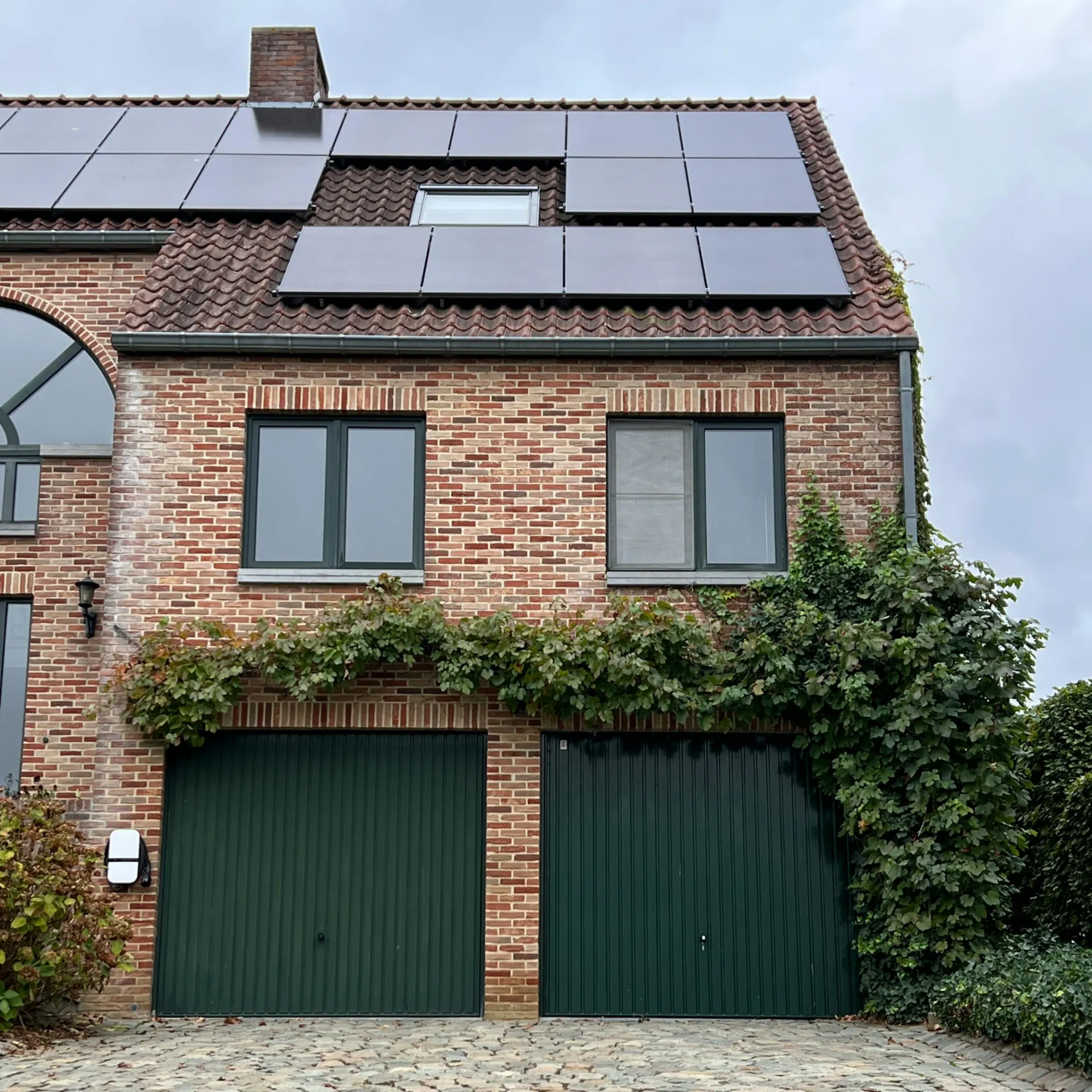
Surrey
Solar Panel Installation in Surrey
HIES Consumer Code member · NAPIT registered · MCS certified · Trustpilot reviewed
Surrey's housing was built for space. Wide semis and detached homes line the railway corridors that carried generations of commuters into London, from Guildford and Woking up through Weybridge and Epsom, and out west to Farnham and Camberley. All that roof — and the energy bills that come with larger family homes — is exactly where solar earns its keep.
Home Comfort Enterprises (HCE) installs solar panels, battery storage and EV chargers for homes across Surrey. We're MCS-certified, NAPIT-registered and members of the HIES Consumer Code, and our approach hasn't changed since we started in 2021: no pressure, just clear advice. If your roof doesn't suit solar, we'll tell you that before you spend anything.
The town pages go a level deeper than this one — solar panels Guildford carries a PVGIS yield run for the town itself — and the county's rules on conservation areas, the Surrey Hills and listed homes are set out in planning permission for solar panels in Surrey.
Quick answer
Solar panels in Surrey:
- The Met Office station at Wisley records 1,584 hours of sunshine a year — about 13% above the UK norm
- 32.2% of Surrey households live in detached houses (2021 Census), with another 29.2% in semis: house-sized roofs
- Surrey County Council has run Solar Together group-buying rounds; HCE quotes independently, whenever suits you
- Typical national install cost: around £7,600 for a 4.5 kWp system (Energy Saving Trust, 27 August 2026) — a UK figure, not a Surrey price
- HIES Consumer Code member, NAPIT registered and MCS certified
- The 0% VAT window on solar and batteries runs until 31 March 2027
Figures: Met Office / ONS / Surrey County Council / Energy Saving Trust (27 August 2026).
Why solar works in Surrey
Start with the light. The Met Office weather station at Wisley — in the middle of the county, near Woking — records an average of 1,584 hours of sunshine a year over the 1991–2020 period. The UK as a whole averages around 1,400 hours, so a Surrey roof sees roughly 13% more sun than the national norm. Panels generate from daylight rather than direct sunshine alone, but more bright hours means more output, year in, year out.
Then the roofs. At the 2021 Census, 32.2% of Surrey households lived in detached houses — well above the South East average of 28.0% and the England figure of 22.9% — with another 29.2% in semis. That's more than six in ten households with a house-sized roof to work with. One honest caveat from experience with this housing stock: the interwar semis along the A3 and the Portsmouth line often have hipped roofs, which shorten the usable south-facing slope. It's why we survey properly rather than quoting from a satellite photo.
The direction of travel locally is clear too. Surrey County Council declared a climate emergency in 2019 and its Greener Futures programme targets a net-zero Surrey by 2050, with the council's own operations aiming for 2030. The council has also run Solar Together Surrey, a group-buying scheme that invites householders to register for vetted, competitively bid installations — a sign of how mainstream home solar has become in the county. You don't need to wait for a scheme round to open, though; HCE quotes independently, whenever suits you.
There's headroom in the housing itself. Homes in the South East have a median energy efficiency score of 70 — just inside band C, and slightly ahead of the England median of 69 (ONS, ten years to March 2025). Decent, but most homes still sit a long way from the point where electricity bills stop stinging. Generating your own supply attacks the problem from the other side.
And if you want proof that Surrey's climate rewards a south-facing slope, consider Denbies in Dorking — 265 acres of vines on the chalk of the North Downs, one of England's largest vineyards. Grapes are far fussier about light than photovoltaic panels are.
What solar costs on a Surrey home
The honest national anchor is the Energy Saving Trust's: a typical domestic system is around 4.5 kWp — around 12 panels over 20 to 30m² of roof — and costs around £7,600 installed, on figures updated 27 August 2026. DESNZ's own cost data for 2025/26, published in May 2026 from 264,742 installations, puts the median at £1,546 per kW for 4–10 kW systems and the domestic retrofit mean at £1,651 per kW — so an average 4.5 kWp retrofit lands in the £7,000 to £7,400 range before the roof, the scaffolding and the inverter choice move it. Surrey's detached and semi-detached stock tends to push system size up rather than down, which is the main reason a county quote so often sits above the national figure.
What a Surrey roof generates is the other half of the sum, and it is reproducible. We ran the European Commission's PVGIS 5.3 (European Commission Joint Research Centre) on the house parameters — 4 kWp, 35° tilt, due south, 14% system losses, building-mounted — for two of the county's towns: Guildford is estimated at about 3,974 kWh a year for a 4 kWp array (around 993 kWh per kWp) and Woking at about 3,984 kWh (PVGIS-SARAH3, 2005–2023). East- or west-facing slopes generate less, and shading changes the answer more than the town does. Installations carry 0% VAT until 31 March 2027, reverting to 5% from 1 April 2027, and export payments are set by each supplier and must be above zero — they change on short notice, which is why we never print one. The full line-by-line picture — what is in the price, what moves it, grants and loans — is on our solar panel installation cost page.
Sources: Energy Saving Trust — Solar panels: costs, savings and benefits explained (updated 27 August 2026) · DESNZ, Solar PV cost data (May 2026) · PVGIS 5.3 (European Commission Joint Research Centre), run 12 October 2026 · HMRC — VAT on energy-saving materials and heating equipment (VAT Notice 708/6).
What we install
HCE designs and installs complete home energy systems: solar panels, battery storage, inverters and EV charge points. We size systems to how your household actually uses electricity, not to how many panels the roof could physically hold — an oversized array on the wrong tariff helps nobody.
We install EnSmart battery and inverter systems, among other equipment from established manufacturers. On lifespan, we'll give you the honest version: solar panels are designed to last 25–30 years, while batteries and inverters carry bounded manufacturer warranties — typically around a decade — and should be planned for accordingly. Anyone promising a "lifetime" battery is selling, not advising.
Start with a conversation
How it works — without the hard sell
Every Surrey enquiry follows the same three steps. First, an initial consultation: a free, no-obligation callback to talk through your home, usage and budget. Second, your design and survey — we check the roof, the loft, the consumer unit and the shading, then put a written, itemised quote in front of you. Third, the installation itself, which for most homes takes one to two days. Between the quote and the install, the pace is yours. Nobody from HCE will chase you into a decision.
Solar panels in Surrey — common questions
Do I need planning permission for solar panels in Surrey?
Usually not — roof-mounted solar on a house in England is permitted development under Class A of Part 14 of the GPDO, as amended from 27 August 2026, provided the panels project no more than 0.2 m from a pitched roof, sit no higher than the highest part of the roof excluding chimneys, and rise no more than 0.6 m above a flat roof. Surrey has more protected landscape than most counties: the Surrey Hills National Landscape covers 422 km², around a quarter of the county, and towns such as Guildford and Farnham have conservation areas. The rule there is narrower than most people think — the exclusion applies to equipment on a wall, balcony or roof enclosure fronting a highway, not to roof slopes — while a flat-roof array on conservation-area or National Landscape land needs a prior-approval determination from the council first, listed buildings always need listed building consent, and an Article 4 direction can remove rights street by street. We flag any planning question we spot at survey stage.
Is my Surrey home actually suitable?
Most are, but not all — and we’d rather rule yours out early than install something that underperforms. The strongest candidates have an unshaded roof face between south-east and south-west, which Surrey’s detached and semi-detached stock offers more often than most of England. Heavy tree cover is the county’s most common complication; leafy plots in the Hills and along the North Downs sometimes shade a roof for enough of the day to change the numbers. A survey settles it either way.
Is there VAT on solar panels?
No — domestic installations of solar panels and batteries are zero-rated for VAT in Great Britain until 31 March 2027, under the government’s energy-saving materials relief. That’s a meaningful saving on a four-figure purchase, and it applies automatically through your installer; there’s nothing to claim.
How much could a Surrey household save?
It depends on your usage, roof and tariff — a self-generated unit of electricity is a unit you don’t buy, and exported surplus earns money through the Smart Export Guarantee. Larger Surrey homes with daytime usage (home workers, heat pumps, EVs) tend to see the strongest returns. We’ve set out the full picture, with worked examples, in our guide to how much solar panels can save.
Does the Surrey Hills National Landscape stop me fitting solar panels?
No. A National Landscape (the former AONB designation) is article 2(3) land, and the only change that makes for a house is that a flat-roof array needs an application to the council for a determination on whether prior approval of its appearance is required before work starts. Panels on a pitched roof slope stay permitted development on the ordinary conditions — no more than 0.2 m proud of the slope and no higher than the highest part of the roof, excluding chimneys. Listed buildings need listed building consent wherever they are, and a conservation area inside the Hills adds its own narrow exclusion for equipment on a wall, balcony or roof enclosure fronting a highway. The 422 km² of the Surrey Hills covers around a quarter of the county, so this comes up a lot at survey.
What does a Surrey roof actually generate?
We ran the European Commission’s PVGIS 5.3 tool rather than quote a generic yield. On the same parameters for every town — a 4 kWp array at 35° facing due south, 14% system losses, building-mounted, PVGIS-SARAH3 data for 2005–2023 — Guildford comes out at about 3,974 kWh a year and Woking at about 3,984 kWh, which is roughly 993 to 996 kWh per kWp. For scale, Ofgem’s typical domestic consumption value from 1 July 2026 is 2,500 kWh a year, so a 4 kWp array generates more than a typical home uses across the year; how much of it you use yourself depends on when you are at home, which is exactly what the survey asks. East- and west-facing slopes generate less, and shading changes the number more than the town does.
Towns we cover
Local pages for Surrey towns
Every town page below is written from named public sources — census housing data, council schemes, local planning context — not template filler.
-
Guildford
In and around Guildford
-
Godalming
3.9 miles from Guildford
-
Woking
5.9 miles from Guildford
-
Cranleigh
7.6 miles from Guildford
-
Cobham
9.5 miles from Guildford
-
Farnham
9.8 miles from Guildford
-
Camberley
10.4 miles from Guildford
-
Dorking
10.4 miles from Guildford
-
Weybridge
10.6 miles from Guildford
-
Leatherhead
11.3 miles from Guildford
-
Virginia Water
11.5 miles from Guildford
-
Haslemere
11.8 miles from Guildford
-
Walton-on-Thames
12.3 miles from Guildford
-
Esher
12.9 miles from Guildford
-
Egham
13.6 miles from Guildford
-
Staines-upon-Thames
14 miles from Guildford
-
Epsom
14.8 miles from Guildford
-
Reigate
15.9 miles from Guildford
-
Ewell
15.9 miles from Guildford
-
Redhill
17.5 miles from Guildford
-
Horley
18.3 miles from Guildford
-
Caterham
21.6 miles from Guildford
Get a straight answer for your Surrey home
Request a free, no-obligation quote or a callback and we'll tell you plainly whether solar stacks up for your roof — and what it would cost, itemised in writing. Call HCE on 0204 547 1892 or use the form. Go Green, Go Solar, Go HCE.
Also see: solar panel installation in Hampshire · our East and West Sussex page · solar panels across Berkshire · south-west London