
Battery Storage
Tesla Powerwall 3 Installation for UK Homes
Quick answer
Tesla Powerwall 3 installation for UK homes:
- A home battery with a built-in solar inverter, suited to households wanting serious capacity, high output or whole-home backup (with Tesla's Backup Gateway 2).
- Tesla's UK quote page (read 25 September 2026): £5,000 without Gateway (Remote Meter extra), £5,975 with, excluding VAT, delivery and installation. Octopus publishes £7,999 on April 2026 prices.
- 13.5 kWh per unit; continuous power configurable up to 11.04 kW to suit your grid connection; up to 20 kW solar DC input (Tesla UK datasheet).
- Tesla's ten-year warranty (80% retained at ten years for UK installations) applies only to units bought from Tesla or a Tesla certified installer; full term needs registration and connectivity.
- Residential installations carry 0% VAT until 31 March 2027, reverting to 5% from 1 April 2027.
- Free, no-obligation consultation; if a Powerwall 3 is the system you want, we will confirm in writing how it would be supplied, who installs and commissions it, and what warranty attaches. If your evening usage is modest, a smaller modular system may pay back faster.
Figures: Tesla UK datasheet; Tesla Powerwall Warranty (European Warranty Region); Tesla UK quote page, read 25 September 2026; Octopus Energy (April 2026 prices); HMRC VAT Notice 708/6.
Tesla's Powerwall is the product that put home batteries into everyday conversation, and the current version — the Powerwall 3 — is a genuinely different machine from the one most people picture: it stores 13.5 kWh of energy and has a solar inverter built in, so a new solar-plus-battery home needs one box where older designs needed two. This page sets out what the product actually does for UK homes — using Tesla's own published figures, not folklore. The battery systems in HCE's own job photos, across our battery storage and solar panel work, are EnSmart; if a Powerwall 3 is the system you want, ask us and we will confirm in writing how it would be supplied, who installs and commissions it, and what warranty attaches.
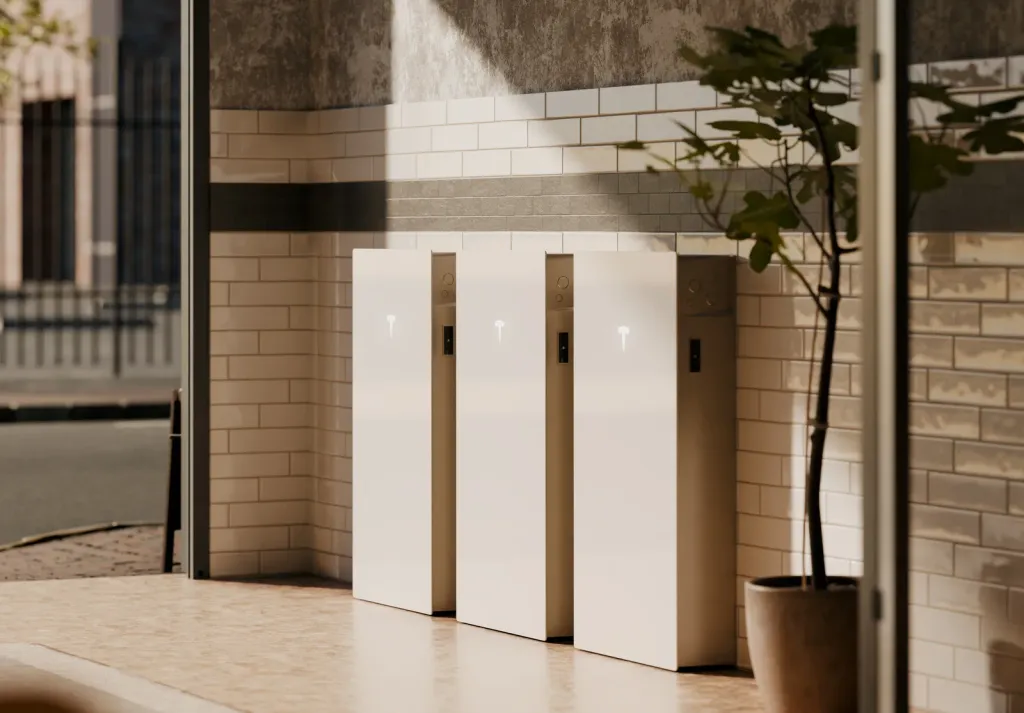 Manufacturer image
 Powerwall 3 in plain numbers
Everything below comes from Tesla's UK datasheet:
- 13.5 kWh nominal battery energy per unit.
- Continuous power configurable up to 11.04 kW — in the UK the output is set to suit your connection, in steps from 3.68 kW up to the maximum, agreed with your district network operator.
- Charges at up to 5 kW continuous from solar or grid.
- Starts heavy loads up to 185 A LRA — the muscle to start motor loads such as pumps and compressors.
- Up to 20 kW of solar DC input across 3 MPPTs, because the solar inverter is integrated rather than a separate unit. Tesla publishes two efficiency figures, and they are not interchangeable: 97.5% solar to home or grid, and 89% when the energy goes solar → battery → home or grid. No figure labelled "round-trip efficiency" appears on the UK datasheet, so treat any page quoting one as an estimate.
- Scales to 4 Powerwall 3 units for power, plus up to 3 battery-only Expansion units for energy — a maximum of 7 units, 44 kW and 94.5 kWh on one site. Tesla's marketing page reads as though the ceiling is higher; the datasheet is the number to plan from.
- Built for outdoors: IP55 enclosure, with an IP67 ingress rating on the battery and power electronics and IP55 on the wiring compartment; operating range −20°C to 50°C (de-rating above 40°C), floor or wall mounted, and quiet — under 50 dB(A) typical and under 62 dB(A) maximum at one metre, about the level of a modern fridge.
- UK grid compliance (G98, G99, G100) is listed on the datasheet itself, which matters because it is what your DNO application relies on.
One honest note on size and weight: a Powerwall 3 is 1105 × 609 × 193 mm and 130 kg, and an Expansion unit is 1105 × 609 × 168 mm and 118.5 kg wall-mounted. They are handsome units, but each is a two-person lift and needs a properly planned position — something to resolve at survey, not on the day.
 Manufacturer image
 What makes it different
Two things stand out in day-to-day use. First, the integration: solar input, battery storage and the household connection are managed by one device and one app, and the Tesla app's monitoring is detailed and clearly presented. Second, backup: paired with Tesla's Backup Gateway 2, the Powerwall 3 can island your home from the grid during a power cut and run either the whole house or the circuits you nominate. Tesla's own documentation shows whole-home and partial-home backup configurations, and the right one depends on your consumer unit and what you actually need through an outage.
Existing solar owners are not left out. The Powerwall 3 supports AC-coupled configurations alongside an existing solar inverter, as well as DC-coupled new arrays — so it can be added to an existing solar system, whoever originally installed it.
The warranty, and the condition most pages leave out
Tesla's Powerwall warranty for the European Warranty Region — the United Kingdom is named in it — is a ten-year promise with conditions attached. The figures first, then the condition that decides whether they apply to you.
- Ten years from the initial installation date, covering defects. The warrantor is Tesla Motors Netherlands B.V.
- 13.5 kWh on day one, 80% retained at ten years for UK installations — the higher of Tesla's two regional retention bands.
- "Unlimited cycles" is scoped, not open-ended. It applies to solar self-consumption, time-based control and backup — how almost every UK home runs one. Any other application, or a combination Tesla does not list, is capped at 37.8 MWh of aggregate throughput instead.
- Internet connection is a condition of the full term: without connectivity for remote firmware updates, or without registration, Tesla says it may not honour the whole ten years, though it commits to at least four.
- It transfers to a later owner of the property who can show proof of ownership.
The condition: who sold it, and who installed it
Tesla's document opens by limiting the warranty to a Powerwall that "was purchased from Tesla or a Tesla certified installer in the European Warranty Region". Separately, among the grounds on which cover "may result in your Warranty being voided", it lists installation, commissioning or repair "performed by anyone other than Tesla or a Tesla certified installer". Tesla also tells buyers directly: "Please contact Tesla if you have any concerns regarding whether you purchased your Powerwall from a Tesla certified installer."
So the ten years is not a property of the hardware. It is a property of the supply chain the hardware came through — and almost no page selling Powerwall installation says so. Two practical consequences. Registration, which protects the full term, is something Tesla expects the certified installer who sold the unit to offer at commissioning. And the enhanced UK consumer rights in the document's United Kingdom appendix — the 30-day rejection right, no refurbished parts on repair — are written for consumers who bought directly from Tesla, not through an installer.
What to do with that, whoever you buy from: check your postcode in Tesla's own certified-installer finder, and ask the company quoting you to confirm in writing how the unit is supplied and what warranty attaches to it. We will not claim a status on this page that you cannot check for yourself — ask us the same question and you will get the answer in writing. If the Tesla warranty matters more to you than anything else about the system, that answer should decide the order you buy in, not the price.
What a Powerwall 3 costs in the UK
Tesla's UK marketing page shows no price — but its quote page does, and the figures are worth knowing before anyone quotes you. Read on 25 September 2026, Tesla listed one Powerwall 3 without a Gateway at £5,000, with a Gateway at £5,975, and with an Expansion unit added at £9,000 and £9,975 respectively. Those are hardware prices marked as excluding VAT, delivery and installation, and the £5,000 line also needs a Tesla Remote Meter that is not in the price. The full cost picture — those figures set against the four decisions that move an installed quote and what the warranty requires of the supply chain — is on our Tesla Powerwall 3 cost page.
For a named company's figure, Octopus Energy publishes a battery price of £7,999 for a 13.5 kWh Powerwall 3, on a page that states its costs are based on April 2026 prices; the page does not say whether installation or VAT is included, so read it as a battery price rather than an installed one (re-read 14 October 2026). We quote those two sources rather than the "£8,500–£12,000 installed" ranges that circulate on comparison sites, because those ranges are aggregates of other people's jobs with no stated basis.
What moves the number for your house: whether a Backup Gateway 2 is in the design, how far the cable run is, whether an existing inverter stays or goes, single- or three-phase supply, and whether the grid connection falls inside G98 or needs a G99 application. Residential installations carry 0% VAT until 31 March 2027, reverting to 5% from 1 April 2027. An installed figure should come from a survey, and be itemised so you can see which of those five things you are paying for.
Backup: what you actually get, and what you don't
A Powerwall 3 only keeps your home running through a power cut if it is installed in a backup configuration, and that means a Backup Gateway 2. Tesla is explicit: the Gateway is required for any backup configuration, and in the cheaper non-backup arrangement — where a Tesla Remote Meter does the metering instead — "Powerwall 3 with Non-Backup configuration will not provide backup power" during an outage.
Tesla's UK datasheet documents whole-home backup alongside two partial-home configurations and an AC-coupled variant, so the design choice is real: everything, or the circuits you nominate. One more detail that catches retrofits out — where existing panels run through a third-party inverter, that inverter's solar will not carry on generating into the backed-up home unless the design accounts for it.
None of this is Tesla-specific: every grid-tied battery must disconnect in an outage unless it is designed to island safely. It matters here because backup is the single biggest swing factor between two Powerwall quotes, and the cheaper one is sometimes cheaper because it does not include the thing you assumed you were buying. Say at the survey whether outage cover matters to you, and the design will say so in writing either way.
The grid paperwork, and the output setting behind it
The Powerwall 3's AC output is configurable: Tesla's UK datasheet lists 3.68, 5, 6, 7, 8, 9, 10 and 11.04 kW at 230 V, with a maximum continuous current of 48 A. That list is not trivia. Under the Energy Networks Association's rules a system of up to 16 A per phase — 3.68 kW on a single-phase supply — is connected first and notified to the network operator within 28 days under G98. Above that, a G99 application goes in before installation and the connection waits for approval. The Powerwall's own compliance block lists G98, G99 and G100, which is what your network operator's paperwork relies on.
In practice this is a design decision with a timescale attached: set the output at 3.68 kW and the job can proceed on notification; ask for the full 11.04 kW and the DNO decides when. The Powerwall 3 itself is single-phase; Backup Gateway 2 supports single- and three-phase feed-in, with 230 V line-to-line not supported. Any quote should tell you which route your design needs, because G99 approval is the part of a battery project most likely to move the start date.
Whichever battery you end up with, the same paperwork applies — there is more on how it works on our solar battery storage page, and the cost side sits on the solar battery storage cost page.
Who the Powerwall 3 suits
The Powerwall 3 fits households that want serious capacity and output in one step: 13.5 kWh comfortably covers a typical family evening, and the high continuous output means electric showers, ovens and car charging do not force the system back onto grid import. It is also the natural choice if whole-home backup is a priority, because the Backup Gateway pairing is mature and well documented.
The flip side of a fixed-capacity unit is that you cannot buy half of one. If your evening usage is modest, a smaller modular system — a Sigenergy SigenStor starting at one module, or an EcoFlow PowerOcean at 5 kWh — may pay back faster. Both should be modelled against your actual usage before either is recommended.
How a Powerwall 3 installation should work
- Step 1
Initial consultation
Any installer should start with your usage, your tariff and what you want the battery to do — savings, backup, or both. Talking it through with us is free, and no obligation.
- Step 2
Your design and survey
The survey should confirm the mounting position, the DNO application, whether backup circuits are wanted, and how the Powerwall pairs with new or existing solar.
- Step 3
Final installation
The installer installs and commissions the system, sets up the Tesla app on your phone and hands over an itemised pack, with the supply chain in writing — who supplied the unit and what warranty attaches to it.
HCE is MCS-certified, NAPIT-registered and a member of the HIES Consumer Code.
By region
By region
Region by region: the housing, the network operators and the sunshine figures that shape how this system would fit.
Hampshire
Berkshire
South West London
North London
Hertfordshire
Bedfordshire
Buckinghamshire
Tesla Powerwall FAQs
How many Powerwalls do I need?
One, for most homes. A single Powerwall 3 stores 13.5 kWh — more than a typical UK household uses across an evening and overnight — and supplies up to 11.04 kW continuously where the connection allows. Tesla’s datasheet allows up to four Powerwall 3 units plus three battery-only Expansions on one site — seven units, 94.5 kWh — but multi-unit systems make sense mainly for very large properties or heavy overnight loads such as multiple EVs. Sizing should come from your actual consumption data at survey rather than defaulting to more hardware.
Will it work with my existing solar panels?
Yes. The Powerwall 3 supports AC-coupled configurations, meaning it can sit alongside your existing solar inverter and store your surplus generation. If you are having new panels fitted, it can instead take up to 20 kW of solar DC directly across its 3 MPPT inputs, doing the inverter’s job itself and saving a separate unit on the wall.
What happens in a power cut?
With the Backup Gateway 2 installed, the system detects the outage and switches your home onto battery power — whole-home or nominated essential circuits, depending on the design agreed with your installer. Without a Backup Gateway, a grid-tied battery must shut down in an outage for safety reasons, which is true of every brand, not just Tesla. If backup matters to you, say so at the consultation stage so the design includes it from the start.
How much does a Tesla Powerwall 3 cost in the UK?
Tesla publishes indicative hardware prices on its UK quote page: read on 25 September 2026, one Powerwall 3 was £5,000 without a Gateway and £5,975 with one, excluding VAT, delivery and installation — and the cheaper line also needs a Tesla Remote Meter that is not included. Octopus Energy publishes a battery price of £7,999 for a 13.5 kWh Powerwall 3 on a stated April 2026 price basis; its page does not say whether installation or VAT is included. Residential installations carry 0% VAT until 31 March 2027. What moves your own number is the Backup Gateway, the cable run, whether an existing inverter stays, and whether the connection falls inside G98 or needs a G99 application — so an installed figure should come from a survey and arrive itemised.
Does the Tesla warranty apply whoever installs it?
No, and this is the part worth reading twice. Tesla’s warranty applies to a Powerwall that "was purchased from Tesla or a Tesla certified installer in the European Warranty Region", and it separately lists installation, commissioning or repair by anyone other than Tesla or a Tesla certified installer among the grounds on which cover may be voided. Tesla invites buyers to contact it if they are unsure whether their seller was certified. Before you commit to any supplier, check your postcode in Tesla’s certified-installer finder and ask the company quoting you to confirm in writing how the unit is supplied and what warranty attaches.
How many Powerwall 3 units and Expansions can one home have?
Tesla’s UK datasheet sets the ceiling at four Powerwall 3 units for power plus up to three battery-only Expansion units for energy — seven units in total, 44 kW and 94.5 kWh. Each Expansion adds 13.5 kWh without adding inverter capacity, which is why they are the cheaper way to buy depth rather than output. Tesla’s marketing page reads as though the ceiling is larger; the datasheet is the number to design from, and almost no UK home needs anywhere near it.
Will it work with my existing solar inverter?
Usually. Tesla states that Powerwall can be integrated with a new or existing solar system, and the AC-coupled route leaves your current inverter in place. The detail that matters on a retrofit is backup: where the existing panels run through a third-party inverter, that solar will not necessarily keep generating into a backed-up home during an outage unless the design accounts for it. A survey establishes which route is cheaper for your house — and if a hybrid replacement is the better answer, we will say so.
Is the Powerwall 3 noisy?
No — Tesla’s datasheet rates it under 50 dB(A) in typical operation, with a 62 dB(A) maximum. In practice that is comparable to a refrigerator, and it is rated for indoor or outdoor installation, from −20°C to 50°C. Position still matters for both acoustics and battery longevity, which is one of the things a survey should settle.
If you want straight answers on whether a Powerwall 3 earns its price for your home, ask us or call 0204 547 1892 — no pressure, just clear advice. Comparing options? Read our SigenStor vs Powerwall 3 comparison or browse the other home battery brands we compare. Its 13.5 kWh capacity is a natural fit for the larger, high-evening-usage Hampshire homes our county page describes.