
Convenience
The convenience argument is simple: you plug in when you get home and wake up to a full battery, the same way your phone charges overnight. No queuing, no apps for someone else's network, no detours.
Enjoy fast, convenient charging at home with professionally installed EV charging systems compatible with a wide range of electric vehicles.
HIES Consumer Code member · NAPIT registered · MCS certified · Trustpilot reviewed
For most drivers, home is where the car spends its nights — which makes a home chargepoint the cheapest and most convenient way to run an EV, particularly on an off-peak electricity tariff. HCE Ltd installs smart home EV chargers as standalone jobs or alongside solar panels and battery storage, with the electrical work carried out by qualified, NAPIT-registered installers.
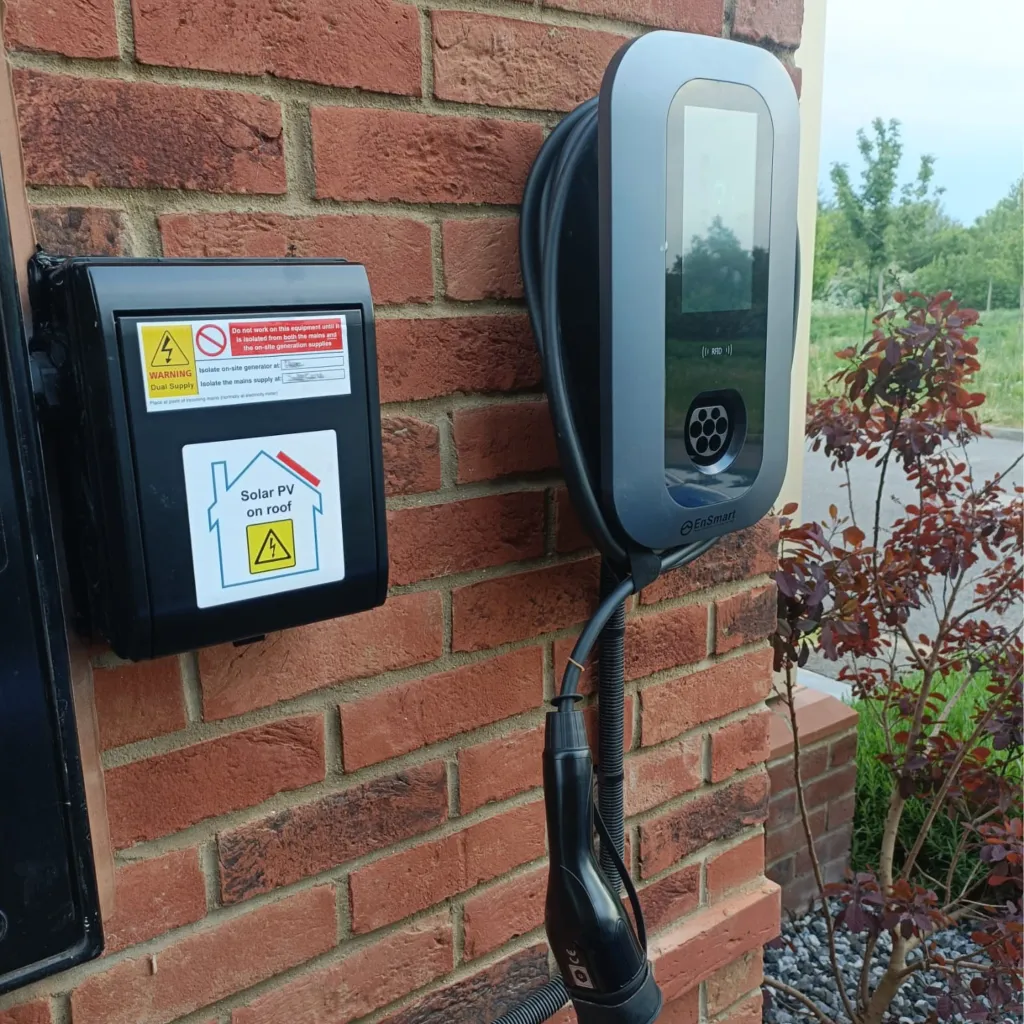
The charger pictured on this page is an EnSmart unit fitted on a real HCE installation. Below: how charging speeds actually work, what installation involves, how solar and an EV fit together, and the current grant picture — told straight.
Parking, driveways and council rules vary by area, so the county pages carry the local side of the same job: start with our Surrey page, or read about EV charging across Sussex and EV charger installation for Hampshire.
Quick answer
Home EV charger installation:
Grant and scheme details: GOV.UK, verified July 2026 — eligibility depends on your circumstances.
A proper installation is an electrical job, not a DIY bracket-hanging exercise. Here's the shape of it.
We check your electrical supply and main fuse capacity, the condition of your consumer unit, the earthing arrangement, where the charger should sit relative to where you actually park, and the cable route from the consumer unit to the charge point. This is also where we confirm your car's connector and on-board charging capability, and whether you want a tethered unit or a socket.
New chargepoints are notified to your local electricity network operator (the DNO) — that's part of the job, handled for you. High-demand devices like EV chargers matter to the network, and the paperwork keeps everything above board.
The charger goes on the wall, a dedicated circuit is run from your consumer unit with the appropriate protective devices, and the unit is commissioned, tested and connected to your WiFi. You'll get a demonstration of the app and scheduling before we leave, plus the electrical certification for the work. Most straightforward home installations are completed within a day.
Modern chargers have made installations tidier than they used to be: the EnSmart units we fit include built-in AC and DC residual-current protection on the manufacturer's specification, and their IP65 rating means they're properly sealed for outdoor wall mounting.
The convenience argument is simple: you plug in when you get home and wake up to a full battery, the same way your phone charges overnight. No queuing, no apps for someone else's network, no detours.
The cost argument is usually stronger. Home electricity — especially on a time-of-use tariff with a cheap overnight window — typically costs far less per unit than public rapid charging, where you're paying for the speed and the infrastructure. Many suppliers now offer EV-specific tariffs with low overnight rates designed exactly for this, and a smart charger schedules your charging into those cheap hours automatically. Drivers who charge mostly at home tend to treat public rapid charging the way you'd treat motorway fuel stations: useful on long trips, avoidable the rest of the time.
There's also a practical point about the alternative. Charging long-term through a standard 3-pin socket ("granny charging") is slow — around 2.3 kW — and a domestic socket isn't designed for that sustained load. A dedicated chargepoint on its own circuit is faster, safer and built for the job.
Charging speed is measured in kilowatts (kW), and the arithmetic is refreshingly simple: a 7 kW charger delivers roughly 7 kWh of energy into your battery per hour of charging.
7 kW — the UK home standard. A 7 kW unit runs on a normal single-phase domestic supply, which is what the overwhelming majority of UK homes have. Worked example: a 60 kWh battery charging from near-empty takes around 8–9 hours — an overnight window — and a typical daily commute's worth of energy goes back in far quicker. This is the sweet spot of cost, speed and compatibility, and it's what we fit for most homes.
22 kW — mostly a red herring for houses. A 22 kW charger needs a three-phase electricity supply, which most UK houses don't have. Upgrading a domestic supply to three-phase is a significant network job with a cost to match, and many EVs' on-board chargers can't accept 22 kW AC anyway — the car, not the wallbox, sets the ceiling on AC charging speed. If someone quotes you a 22 kW home charger without first checking your supply and your car, be sceptical.
DC rapid charging — for the public network. The 50–350 kW rapid chargers you see at motorway services use DC charging at power levels domestic supplies can't provide. They're a different tool for a different job: long-distance top-ups, not overnight charging.
One more honest note: your car's own on-board AC charger limits what it can draw. A car capped at 7.4 kW charges at the same speed on a 22 kW unit as on a 7 kW one. We'll check your car's specification as part of the quote so you're buying the right kit, not the biggest number.
Every new home chargepoint sold in Great Britain must have smart functionality — that's been the law since 30 June 2022 under the Electric Vehicles (Smart Charge Points) Regulations 2021. In practice, a compliant charger can communicate over a network, respond by adjusting its charging rate, and comes pre-configured to favour off-peak charging by default.
That's regulation working in your favour: smart scheduling is what lets the charger fill your car in the cheap overnight window without you thinking about it, and app control means you can check state of charge, review charging history and adjust schedules from the sofa. The EnSmart units we fit connect over WiFi or Ethernet and support the industry OCPP standard, per the published specification — the practical upshot is a charger that plays nicely with tariffs and apps rather than locking you in.
If you have solar panels — or you're considering them — the EV becomes more than a car: it's a large battery that happens to have wheels, and it can soak up your surplus generation.
With a compatible setup, excess solar that would otherwise export to the grid for pennies can be diverted into the car instead, displacing electricity you'd have bought at full price. On a sunny weekend day, a few kilowatt-hours of free driving go into the battery while you get on with your life. Add home battery storage and the choreography gets better still: solar fills the house battery and the car by day, off-peak grid rates top both up overnight in winter, and your peak-rate grid purchases shrink from both directions.
You don't need to do everything at once. Plenty of customers start with the charger and add panels later, or vice versa — what matters is that each installation is designed knowing the other is coming. Tell us your plans at the survey and we'll size and position the kit so the pieces fit together when you're ready.
The wall-mounted charger you can see on this page is an EnSmart unit installed by HCE on a real job — not a press image.
EnSmart Power is a UK-headquartered manufacturer (Braintree, Essex) whose home charging line is the SmartBee-M series. The published specification for the 7 kW single-phase model: Type 2 connection in socketed or tethered form, WiFi and Ethernet connectivity, RFID cards for access control, an LCD status screen, OCPP 1.6 support, built-in AC 30 mA Type-A and DC 6 mA residual-current protection, an IP65 weatherproof rating, and a 2-year manufacturer warranty (as listed by its UK distributor). A 22 kW three-phase version exists for properties that genuinely have the supply for it.
Grant funding for home chargepoints still exists in 2026, but it's narrower than the headlines suggest — and plenty of pages online are out of date. The current position on GOV.UK:
Eligibility has paperwork attached (evidence of tenancy or lease, an eligible vehicle, and the claim being made through an OZEV-authorised installer), so tell us your situation at the quote stage and we'll confirm honestly whether a grant applies to you before any figures are agreed.
Usually not. A wall-mounted charger within an area lawfully used for off-street parking, such as beside a drive or in a garage, is permitted development under Part 2, Class D of the General Permitted Development Order, and a post (an upstand) can be too, up to 1.6 m high at a house.
The rules changed on 21 October 2026. The amendment order, S.I. 2026/1056, extends permitted development to one charger elsewhere within the grounds of a house or block of flats, though not in a conservation area. It also sets limits that matter for homes near the street:
Work that was permitted under the old wording can still be carried out until 20 October 2027. A listed building, a conservation area or an Article 4 direction can still mean an application, so for those homes we ask the council before anything is fitted, and say so in the quote.
Source: The Town and Country Planning (General Permitted Development) (England) (Amendment) (No. 2) Order 2026 (made 25 September 2026, in force 21 October 2026) and the 2015 Order, Schedule 2, Part 2, read 20 October 2026.
We do not publish a price list, for the same reason no honest installer does: the spread between a garage wall beside the consumer unit and the far corner of a house with a driveway in between is genuine. What we can do is show you what sits in the price, so that two quotes become comparable:
For the national picture and what each item typically does to the total, we keep a dedicated guide: EV charger installation cost in the UK. And if a quote arrives as one figure with no breakdown, ask for those five lines before you ask for a discount - the cheapest headline is usually the one with a line missing.
A 7.4 kW charger draws 32 A continuously, and domestic main fuses are commonly rated 60 A, 80 A or 100 A - so on a smaller supply a charger plus an electric shower can exceed what comes into the house. The usual answer is not an expensive supply upgrade: it is load management, where a sensor on the incoming supply lets the charger take only the headroom that is spare and ramp back up when the house goes quiet.
That is why most homes can have a 7.4 kW charger without the network operator digging up the path. The survey checks the main fuse rating, the earthing arrangement, the consumer unit and the cable route, and prices whatever needs doing before you commit. The full version, including what each of those four findings means, is in will your fuse take a 7 kW EV charger.
By town
Each town page sets out where a charger can go in that town's homes, its network operator, local plug-in vehicle numbers and what the roof could add in summer.
Surrey
Sussex
Hampshire
Berkshire
South West London
North London
Hertfordshire
Essex
Bedfordshire
Buckinghamshire
Roughly 7 kWh of energy per hour — so divide your battery size by seven for a full-charge estimate. A 60 kWh battery takes around 8–9 hours from near-empty, comfortably inside an overnight window, and a typical day’s driving tops back up in an hour or two. Your car’s on-board charger sets the true ceiling, which we check before quoting.
Tethered (cable permanently attached) wins on day-to-day convenience: park, grab the cable, plug in. Socketed (bring your own cable) is tidier on the wall and more future-proof if you change cars. There’s no wrong answer — the EnSmart SmartBee-M comes in both forms, and we’ll talk it through at the survey based on how you park and who drives.
Yes, with a compatible setup — surplus solar that would otherwise be exported can be diverted into the car, and scheduling can prioritise sunny hours. If you already have panels, bring your system details to the survey; if you’re planning them, see our solar panels page and we’ll design the two installations to work together.
Sometimes. A 7 kW charger adds a significant continuous load, so the survey checks your main fuse, supply capacity and consumer unit before anything is promised. If an upgrade or a load-management device is needed, it appears as a line on your written quote — not as a surprise on installation day.
The SmartBee-M uses a Type 2 connection, the standard fitting on new EVs sold in the UK and Europe for years. Owners of older cars with different connectors use an adapter cable on a socketed unit. Plug-in hybrids charge the same way — their batteries are smaller, so they fill quickly even at modest speeds.
For a conventional installation, yes — a driveway, garage or allocated space where the cable never crosses public ground. If you only have on-street parking, the cross-pavement gully route (with its £500 grant, above) now makes home charging possible for some properties, subject to your council’s rules on the pavement works. It’s honestly not viable for every street, so ask us and we’ll tell you straight.
There is no single number, and anyone publishing one has not seen your house. The price is built from five items: the chargepoint itself, a dedicated circuit with its protective devices, the cable route between the consumer unit and where you park, a load-management device where the supply needs one, and the network operator notification with commissioning and handover. The cable route is the item that most often separates two quotes for the same charger. Our cost guide sets out the national picture item by item; our quote sets out yours, itemised, after a survey.
Usually not. A 7.4 kW charger draws 32 A continuously and domestic main fuses are commonly 60 A, 80 A or 100 A, so on a smaller supply the arithmetic can be tight - but the standard solution is load management rather than a supply upgrade. A current sensor on the incoming supply tells the charger how much headroom is spare, and the charger reduces its own current while the oven and shower are running, then ramps back up. Your car charges slightly more slowly for an hour and the main fuse never approaches its limit. Supply upgrades are reserved for the minority of cases where load management genuinely cannot fit the demand.
Almost never, because 22 kW requires a three-phase supply and the overwhelming majority of UK homes are single-phase. On single-phase the practical ceiling is 7.4 kW, and a 22 kW unit will simply run at 7.4 kW. Where a property genuinely has three phases the next question is the car, because many electric vehicles accept only 7 kW or 11 kW on AC regardless of what the charger can deliver. For overnight charging at home, 7.4 kW fills a typical day of driving in two to three hours inside the cheap window of an EV tariff.
Request a free, no-obligation quote and we'll confirm the right charger for your car, your parking and your tariff — plus whether any grant genuinely applies to you. No pressure, just clear advice.
Get a free quote · Call 0204 547 1892 · See the kit: EnSmart chargers and storage