
Battery Storage
Solar Battery Storage Cost: the UK numbers, and what sits behind them
What home storage actually costs in 2026, why online hardware prices look four times cheaper than an installed quote, and the grant, VAT and warranty facts most cost pages get wrong.
HIES Consumer Code member · NAPIT registered · MCS certified · Trustpilot reviewed
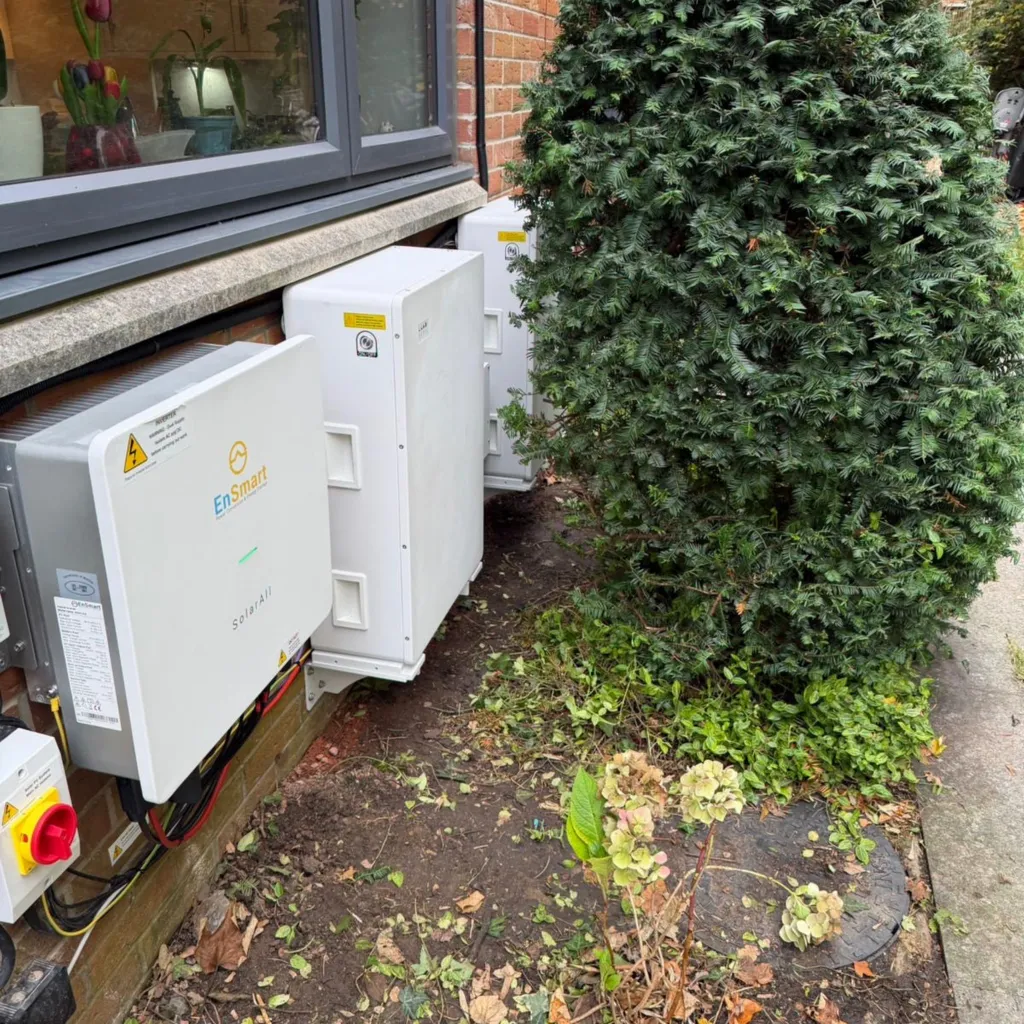
Solar battery storage cost is the question that decides most projects, and it is badly served online: the results for it include a forum thread, a page about hotels and one written in 2018. Here is the honest version, with every figure attributed and dated, and nothing invented. The short answer is that the Energy Saving Trust puts home storage at £1,500 to £10,000, with a 5 kWh system around £4,600 and a typical home system at 10 kWh — and that an installed price and a hardware price are not the same number.
None of the figures on this page is our price. Ours comes from a survey of your roof, your bills and your tariff, and it arrives itemised so you can see what you are paying for. What this page gives you is the benchmark to hold it — or anyone else's — against.
Quick answer
Solar battery storage cost, in short:
- Energy Saving Trust (updated 19 August 2026): £1,500 to £10,000, around £4,600 for a 5 kWh system, typical home system 10 kWh
- Bare hardware sells for a fraction of that — an installed system includes the work, the protective devices, the network paperwork and the certification
- 0% VAT until 31 March 2027, then the REDUCED rate of 5% — not 20%, whatever you read elsewhere (HMRC Notice 708/6)
- Warm Homes: Local Grant can fund a battery alongside solar for eligible households; ECO4 scores batteries zero and will not
- A battery usually reduces export payments, and can make you ineligible for some export tariffs (Which?, 15 May 2026)
- Lifespan about 10 to 12 years, so a full-life comparison should include a replacement
Figures: Energy Saving Trust, HMRC, DESNZ, Ofgem and Which? — each cited in the sections below, read 25 September 2026.
Why the prices you see online are four times cheaper
Search for a battery and you will find 10 kWh units advertised for well under £2,000, and retailers selling cells from a few hundred pounds. Search for an installed system and you get the Energy Saving Trust's £4,600 for 5 kWh. Both numbers are real. They describe different purchases, and the gap between them is the single most common reason people think installers overcharge.
An installed price buys the box, and then it buys all of this:
- An MCS-certified installation, which is what keeps an export tariff available to you at all.
- Isolators, protective devices, fire-rated positioning and the cabling between your consumer unit and wherever the battery lives.
- The grid notification or application — G98 after the event, or a G99 application approved before work starts.
- Commissioning, system configuration, the app set up and handover documents.
- A workmanship warranty from a company you can call, sitting alongside the manufacturer's product warranty.
That is why a cheap quote deserves a question rather than a celebration: ask which of those lines is missing. And usable capacity is its own trap — as Which? puts it, "usable capacity is usually less than stated capacity", because batteries lose some energy charging and discharging and most are not designed to be emptied completely. Compare quotes on usable kWh, not the number on the lid.
What decides your number
Six things move a battery quote, and every one of them should be visible on the page you are handed:
- Usable capacity — the kWh you can actually cycle.
- Inverter — a hybrid replacement costs more than an AC-coupled battery next to a healthy existing inverter.
- Backup — keeping circuits alive in a power cut needs extra hardware and wiring, and it is the biggest single swing between two quotes.
- Position and cable run — a garage beside the consumer unit is not a first-floor cupboard at the other end of the house.
- Grid route — inside the G98 limit the job proceeds on notification; above it, a G99 application waits on the network operator.
- Scaffolding and roof work, where panels are part of the same job.
The Energy Saving Trust makes one saving explicit: fitting storage at the same time as panels costs less than a separate visit later, because the team and the scaffolding are already there. If panels are on your list at all, price them together even if you buy them apart.
What size, and therefore what cost
Capacity is the biggest single driver of price, so sizing is a cost question before it is a technical one. The Energy Saving Trust declines to give a formula and says the number depends on your circumstances. Which? offers the most useful neutral anchors: the average home uses between 8 kWh and 10 kWh of electricity a day, new lithium-ion home batteries typically run from around 5 kWh to 15 kWh, and the sensible rule is to cover your evening and overnight use while never buying more capacity than your panels can realistically fill.
That last clause is where money is wasted. A battery your array cannot fill is capital sitting on a wall, and it is the most common oversizing mistake we see on quotes people bring us for a second opinion. The honest method is to look at what you use after dark, check what your roof produces on an average day rather than a July one, and size to the overlap — then leave room to add a module later if your usage changes.
Our savings calculator lets you put your own bill against it, and the solar battery storage hub explains how the two pairing routes differ. If an EV or a heat pump is on the horizon, say so — both change the answer materially.
Want the number for your house?
What a ten-year warranty actually guarantees
Almost every battery is sold on a ten-year warranty, and the years are the least informative part of it. What matters is the retention figure: how much of the original capacity the manufacturer guarantees will still be there at the end of the term, and what conditions keep the promise alive.
Two published examples, both ten-year warranties. Tesla warrants that a Tesla Powerwall 3 retains 80% of its capacity at ten years for UK installations — and separately limits cover to units purchased from Tesla or a Tesla certified installer. Fox ESS's UK and Ireland battery warranty policy (version 4.5, 11 September 2025) guarantees 70% of nominal energy — over 120 months on its EP and CQ packs, 144 months on the EQ and EVO ranges — or a per-model energy throughput, whichever comes first. Same headline, very different promise. Ask for the warranty document, not the brochure line, and read the retention percentage and the conditions before you compare prices.
Lifespan sits next to this. The Energy Saving Trust puts typical battery life at about 10 to 12 years; Which? notes panels can last 25 years or more, so a fair whole-life comparison includes at least one battery replacement. A quote that ignores that is not being straight with you.
VAT, and the one grant that funds batteries
VAT. Installing a battery in a UK home is zero-rated until 31 March 2027. From 1 April 2027 it reverts to the reduced rate of 5%, as HMRC's Notice 708/6 states in two separate sections — not to 20%, which several well-known consumer pages currently say. Since 1 February 2024 the zero rate also covers a standalone battery with no solar attached.
Grants. One scheme funds home batteries in England: the Warm Homes: Local Grant. The policy guidance local authorities work to, updated June 2026, includes domestic batteries — but only where the battery complements existing or newly installed solar PV, and only through an MCS-certified installation meeting MCS 3012, PAS 63100 and PAS 2035. Batteries were added in June 2025, paused that November while an MCS product standard was settled, and reinstated on 2 February 2026. The household gate is an English property, privately owned, with an EPC of D to G and an income usually at or below £36,000 a year; your council runs the scheme and decides.
Two clean negatives, because they save people time. ECO4 does not fund batteries: Ofgem's delivery guidance states a battery can be installed during an ECO4 retrofit but scores nothing, because it does not improve a SAP rating. And while the Warm Homes Plan announced government-backed loans for storage, neither the Energy Saving Trust nor Which? can yet say when they open — so no page, including this one, should quote you a date.
What a battery does to your export income
A battery changes which side of the meter your surplus lands on, and that cuts both ways. Every unit you store and use yourself is a unit you do not buy at the import rate — that is the saving. But Which? is explicit that exports, and therefore export payments, are likely to fall once a battery is in the system, and that a battery can make a household ineligible for some export tariffs altogether.
Under Ofgem's rules, Smart Export Guarantee rates must be above zero, but each supplier sets the rate, the contract length and the terms, so there is no national figure to quote and we do not print one. To receive a tariff at all, GOV.UK requires that both the installation and the installer are MCS-certified, or certified to an accredited equivalent, and that you have a meter capable of half-hourly export readings. Check your own supplier's terms before assuming a battery leaves your export income untouched.
Who stands behind the warranty
A warranty is only as good as the company honouring it, and this market has just proved it. GivEnergy Ltd went into administration on 9 April 2026. Which? reports that installed systems keep working and the app still runs, but that owners with a faulty battery are unlikely to see warranty claims honoured. Nothing about the hardware changed; the company behind the promise did.
So when you compare quotes, compare the backing as well as the number: who the manufacturer is, who the installer is, what the workmanship warranty covers and for how long, and which consumer code applies if something goes wrong. Which? suggests checking your installer is signed up to a consumer code covering storage. We are NAPIT-registered, MCS-certified and members of the HIES Consumer Code — and you can check every one of those on the schemes' own registers rather than taking our word for it.
Solar battery storage cost FAQs
How much does solar battery storage cost in the UK?
The Energy Saving Trust, whose battery advice was updated on 19 August 2026, puts home storage between £1,500 and £10,000, with a 5 kWh system around £4,600 and a typical home system at 10 kWh. Installed quotes cluster in that range and vary with capacity, whether an inverter is part of the job, whether you want backup during a power cut, and how far the cable run is. Residential installations carry 0% VAT until 31 March 2027. Our own figure comes from a survey of your roof, bills and tariff, and arrives itemised.
Why are batteries online so much cheaper than an installed quote?
Because they are different things. A battery on a shelf is a box; an installed system is that box plus a certified installation, the protective devices and isolators, the wiring and mounting, the network operator notification or application, commissioning, and the certification that keeps a Smart Export Guarantee tariff valid. You will see 10 kWh units advertised at well under £2,000 while the Energy Saving Trust puts a 5 kWh installed system at around £4,600 — the difference is the work and the paperwork, not a markup on the box. If a quote looks unusually cheap, ask which of those line items is missing.
How much does it cost to add a battery to an existing solar system?
Usually less than a new system, because the panels and often the inverter are already there. An AC-coupled battery sits alongside your existing inverter and leaves it untouched; if the inverter is old, replacing it with a hybrid unit and adding storage in one visit is often tidier. Two things move the number: whether the existing inverter stays, and whether the new total output stays inside the G98 limit or needs a G99 application to the network operator first. Retrofit batteries carry the same 0% VAT until 31 March 2027, including a standalone battery with no solar at all.
Is there a grant for solar battery storage?
There is one route, and it is narrow. The Warm Homes: Local Grant in England can fund a domestic battery, but the DESNZ guidance councils work to (updated June 2026) allows it only where the battery complements existing or newly installed solar PV, and requires an MCS-certified installation to MCS 3012 with PAS 63100 and PAS 2035. Batteries were added in June 2025, paused in November 2025 and reinstated on 2 February 2026. The householder gate is an English property, privately owned, EPC D to G and a household income usually of £36,000 a year or less. ECO4 is the clean negative: Ofgem guidance scores battery storage at zero because it does not improve a SAP rating, so it will not pay for one. The Warm Homes Plan announced loans for batteries, but no launch date has been published — treat any page quoting one with suspicion.
Does a battery reduce Smart Export Guarantee payments?
Yes, and almost no cost page says so. Which? states plainly that exports and therefore payments are likely to fall once you have a battery, and that a battery may make a household ineligible for some export tariffs. That is not an argument against storage — a unit you use yourself is worth more than a unit you export — but it belongs in the arithmetic. To receive an export tariff at all, GOV.UK requires that both the installation and installer are MCS-certified (or an accredited equivalent) and that you have a meter capable of half-hourly export readings.
How long will a 10 kWh battery last, and will I have to replace it?
The Energy Saving Trust puts typical battery lifespan at about 10 to 12 years, against solar panels that Which? notes can last 25 years or more — so a full-life cost should assume at least one battery replacement. What the warranty guarantees matters more than the headline years: Tesla warrants 80% of capacity retained at ten years on a Powerwall 3, while Fox ESS’s UK and Ireland battery warranty policy guarantees 70% of nominal energy over 120 months on its EP packs and 144 months on the EQ and EVO ranges, or a per-model energy throughput, whichever comes first. Both are ten-year warranties. They are not the same promise.
Want a real number instead of a range?
Send us a recent electricity bill and we will give you an itemised quote: usable capacity, inverter, backup or not, the grid route, and the warranty terms in writing. If a battery would not pay its way on your usage, we will tell you that too — it is a shorter conversation than the alternative. The two halves added up are on solar panels and battery cost, and Tesla's own published figures on Tesla Powerwall 3 cost.
Get a free quote · Call 0204 547 1892 · Still deciding? Solar battery storage explained
Sources: Energy Saving Trust, Battery storage (updated 19 August 2026); HMRC, VAT Notice 708/6; Which?, Solar panel battery storage (15 May 2026); DESNZ, Warm Homes: Local Grant policy guidance for local authorities (updated June 2026); GOV.UK, Apply for the Warm Homes: Local Grant; Ofgem, ECO4 Delivery Guidance v3.2; Ofgem, Smart Export Guarantee; GOV.UK, Smart Export Guarantee; Tesla, Powerwall 3 UK datasheet (2026) and Powerwall Warranty (European Warranty Region) Rev. 1.16; Fox ESS, Battery Warranty Policy — UK & Ireland Only, v4.5 (11 September 2025). All read 25 September 2026.