
What it is
A loan from a participating lender, under a government scheme run by the Department for Energy Security and Net Zero, for home energy improvements. You pay it back on the lender’s terms. It is not a grant.
Government scheme explained
A plain-English guide to the government’s Warm Homes Loan Scheme for solar panels and home batteries in Barnet, Finchley and across North London: who can apply, the most the scheme allows for each improvement, and how to apply. It is a loan from a participating lender, not a grant, and you pay it back. The lender runs its own credit and affordability checks and decides. We are the MCS-certified installer, not the lender.
Solar panels and battery storage. No obligation.
At a glance
The first participating lenders were named on 27 October 2026. Checked against GOV.UK and the scheme rules on 18 November 2026.
A loan from a participating lender, under a government scheme run by the Department for Energy Security and Net Zero, for home energy improvements. You pay it back on the lender’s terms. It is not a grant.
Homeowners anywhere in the UK, with or without a mortgage, and private landlords borrowing personally. The scheme sets no income test, but every lender runs its own credit and affordability checks.
Named low-carbon improvements, such as roof-top solar panels and home batteries. Apart from a heat network connection, each must be fitted by an installer MCS certified for that improvement. Not insulation, and not roof repairs.
To a participating lender, not to the government and not through us. GOV.UK lists the lenders taking part, and the lender decides whether to lend to you and on what terms.
Loan limits
The government sets a maximum loan for each improvement. These are ceilings, not offers: each lender decides whether to lend to you, how much, over what term and on what terms.
The two improvements we are MCS certified to fit
A typical quote includes the scaffolding and the grid connection. The scheme won’t fund roof repairs or other structural work needed first.
That includes a battery added to panels you already have. A typical quote can cover linking it to your existing system, setting up monitoring, and the isolators and protection the battery needs.
| Improvement | Loan limit |
|---|---|
| Air source heat pumpair to water; the limit counts the cost before the Boiler Upgrade Scheme grant comes off, so with the £7,500 grant a lender can lend at most £12,500 | Up to £20,000 |
| Ground source heat pumpincluding water source; counted before any Boiler Upgrade Scheme grant comes off | Up to £35,000 |
| Biomass boilerrural homes only, with a Boiler Upgrade Scheme grant; the limit counts the cost before the grant comes off, so with the £5,000 grant a lender can lend at most £15,000 | Up to £20,000 |
| Micro-renewablesdomestic wind turbines and micro hydro only | Up to £20,000 |
| Heat network connectionthe one improvement that doesn’t need an MCS installer | Up to £7,500 |
| Air-to-air heat pumpnot eligible yet: no MCS certification exists for it | Up to £10,000 |
Our MCS certification covers solar PV and battery storage only, so we can’t fit any of these under the scheme. If we quote you for anything else, such as air conditioning, a heat pump or a boiler, that work can’t go through the scheme with us.
The scheme doesn’t fund insulation, even alongside another improvement, or replacement roofing and other structural work needed before panels go on. It doesn’t pay for gas, oil or LPG boilers, or for anything that isn’t on the scheme’s list.
Source: the government’s Warm Homes Loan Scheme factsheet (27 October 2026) and the scheme rules (version 3, September 2026). You can apply for a loan for more than one improvement, and each keeps its own limit; the lender still runs its own credit and affordability checks and decides. Whichever way you pay, installing solar panels or a battery in a home carries 0% VAT until 31 March 2027, then 5% from 1 April 2027 (HMRC VAT Notice 708/6).
Eligibility
Ownership matters locally, because Warm Homes loans are only for people who own the home: at the 2021 Census, 67.6% of households in High Barnet ward owned their home, against 52.7% across the borough of Barnet.
Five steps
You apply to a lender that offers Warm Homes loans, not to the government. GOV.UK sets out three routes: directly to a participating lender, through your mortgage provider, or through an installer or retailer that arranges finance for the work. We don’t arrange Warm Homes Loans, so with us you apply to the lender yourself. Whichever route you take, the lender runs its own credit and affordability checks and decides.
Ask MCS-certified installers for a written quote, priced for your home after a survey. The scheme rules ask lenders to check that it shows the installer’s MCS number, the installation address, an itemised breakdown and the system size, and is dated within the last six months.
GOV.UK lists the lenders taking part. Compare the APR, the total amount you would repay and how long you would be paying, not just the monthly figure. The government’s factsheet notes that some lenders work only with particular installers, while others let you choose any MCS-certified installer, so check that the lender will lend for work by the installer you choose.
Apply directly or through your mortgage provider. Some installers and retailers also arrange the finance; we don’t arrange Warm Homes Loans. GOV.UK says a loan funded through the scheme will say so in its product details. The lender runs its credit and affordability checks and decides.
An MCS-certified installer fits the system and registers it on the MCS Installation Database, which produces the MCS certificate lenders use to check the work. The government’s factsheet asks you to keep the quote, the finance agreement, the invoice, proof of purchase and the MCS certificate.
Your home may be picked for an audit, by an auditor working for the Department for Energy Security and Net Zero or by MCS. Being picked doesn’t mean anything is wrong. If an auditor working for the Department for Energy Security and Net Zero needs to visit, you will get at least 48 hours’ notice.
Don’t mix them up
Two schemes with similar names and very different rules. If your household is on a lower income, check the grant first: you apply online through GOV.UK, and what is open depends on where you live.
| Warm Homes Loan Scheme | Warm Homes: Local Grant | |
|---|---|---|
| What it is | A loan you pay back, plus any interest the lender charges | A grant: improvements paid for, nothing to repay |
| Who it is for | UK homeowners and private landlords; no income test, but lenders run credit and affordability checks | Lower-income households in England, in homes rated D to G on their Energy Performance Certificate |
| Who runs it | The Department for Energy Security and Net Zero runs the scheme; participating lenders make the loans | Local councils, or the groups delivering it for them, where they have funding |
| How to apply | To a participating lender | Online through GOV.UK, then your council arranges a survey |
| What it pays for | Solar panels, batteries, heat pumps and more | Insulation and low-carbon heating, and sometimes solar panels |
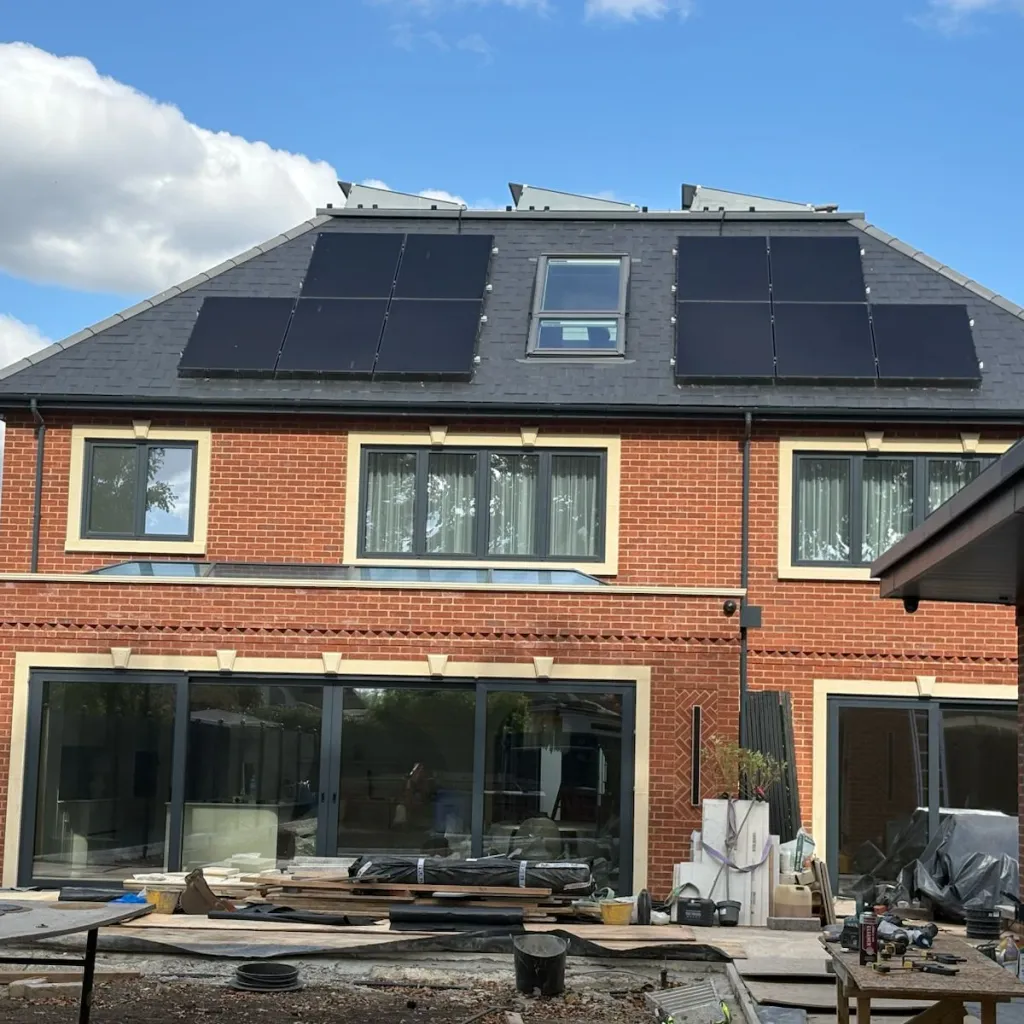
Where we fit in
Home Comfort Enterprises Ltd is MCS certified for solar PV and battery storage (MCS certification number NAP-73495, through NAPIT), which is the installer requirement the scheme sets for those two improvements.
We are not a lender or a credit broker. We don’t arrange or provide finance, and we don’t pass your details to a lender: you apply to a lender yourself. This page is general information about a government scheme, not financial advice.
What we do is survey your roof and your electrics, give you a written, itemised quote, fit the system and register it with MCS. If we quote you for anything else, such as air conditioning, a heat pump or a boiler, that work can’t go through the scheme with us. We also fit EV chargers, but we don’t currently offer one as part of a Warm Homes loan installation.
Questions, complaints and scams
Government schemes attract scammers. Be wary of unexpected calls, texts or doorstep visits offering a Warm Homes loan. You apply to a lender that offers them, not to the government, so check the lender is on GOV.UK’s list of participating lenders before you share any details.
Raise it with the lender first. If it isn’t resolved, you may be able to take it to the Financial Ombudsman Service.
Raise it with the installer first. If you can’t resolve it, GOV.UK says to make a complaint to MCS, which certifies installers.
Ask the lender about its loans. For the scheme itself, GOV.UK gives the DESNZ Warm Homes Loan Scheme team: WHLS@energysecurity.gov.uk.
Report fraud, scams or misuse to Warm Homes Counter Fraud at WHLScounterfraud@energysecurity.gov.uk. Never feel pushed into signing on the spot.
FAQs
No. It is a loan from a participating lender, which you pay back on the lender’s terms. The council-run Warm Homes: Local Grant is a separate scheme for lower-income households in England.
No. We are not a lender or a credit broker, we don’t arrange these loans and we don’t pass your details to a lender: you apply to the lender yourself. We provide the written MCS installation quote the lender asks for.
Each lender sets its own rates, terms and fees, and GOV.UK says to contact the lenders directly about them. We can’t quote or compare them for you. When you compare lenders, look at the APR, the total amount you would repay and how long you would be paying, not just the monthly figure.
The scheme sets no income threshold, but every participating lender runs its own credit and affordability checks and decides whether to lend to you. Lenders can also add conditions of their own, such as asking for an Energy Performance Certificate.
Yes, if you meet the scheme’s conditions and a participating lender agrees to lend to you after its credit and affordability checks. The scheme rules cover a battery on its own as well as one paired with solar panels, including a battery added to panels you already have, up to £15,000.
No. The scheme covers air source heat pumps, but each improvement has to be fitted by an installer MCS certified for that improvement, and our MCS certification covers solar PV and battery storage only. Air-to-air heat pumps, the kind used for air conditioning, aren’t eligible yet because no MCS certification exists for them.
GOV.UK says the loan product will say if it is funded by the government through the Warm Homes Loan Scheme. Check the lender is on GOV.UK’s list of participating lenders before you share any details.
Yes. The scheme covers homes anywhere in the UK, so a home in Barnet, Finchley, Edgware or elsewhere in North London is treated the same as anywhere else. We survey and install across North London and in Bedfordshire.
Sources: GOV.UK’s Warm Homes Loan Scheme guide, the government factsheet (27 October 2026), the scheme rules (version 3, September 2026), GOV.UK’s Warm Homes: Local Grant guide, the MCS installer directory and HMRC VAT Notice 708/6, checked on 18 November 2026. The scheme is new, so details may change: always check GOV.UK and the lender’s own terms.
A no-obligation survey gives you a written, itemised quote for solar panels or a battery on your home in Barnet, North London or Bedfordshire.